
Technology Leadership
Fractional CTO for Mid-Market and PE Portcos
Published Mar 26, 2026. Updated Oct 11, 2026
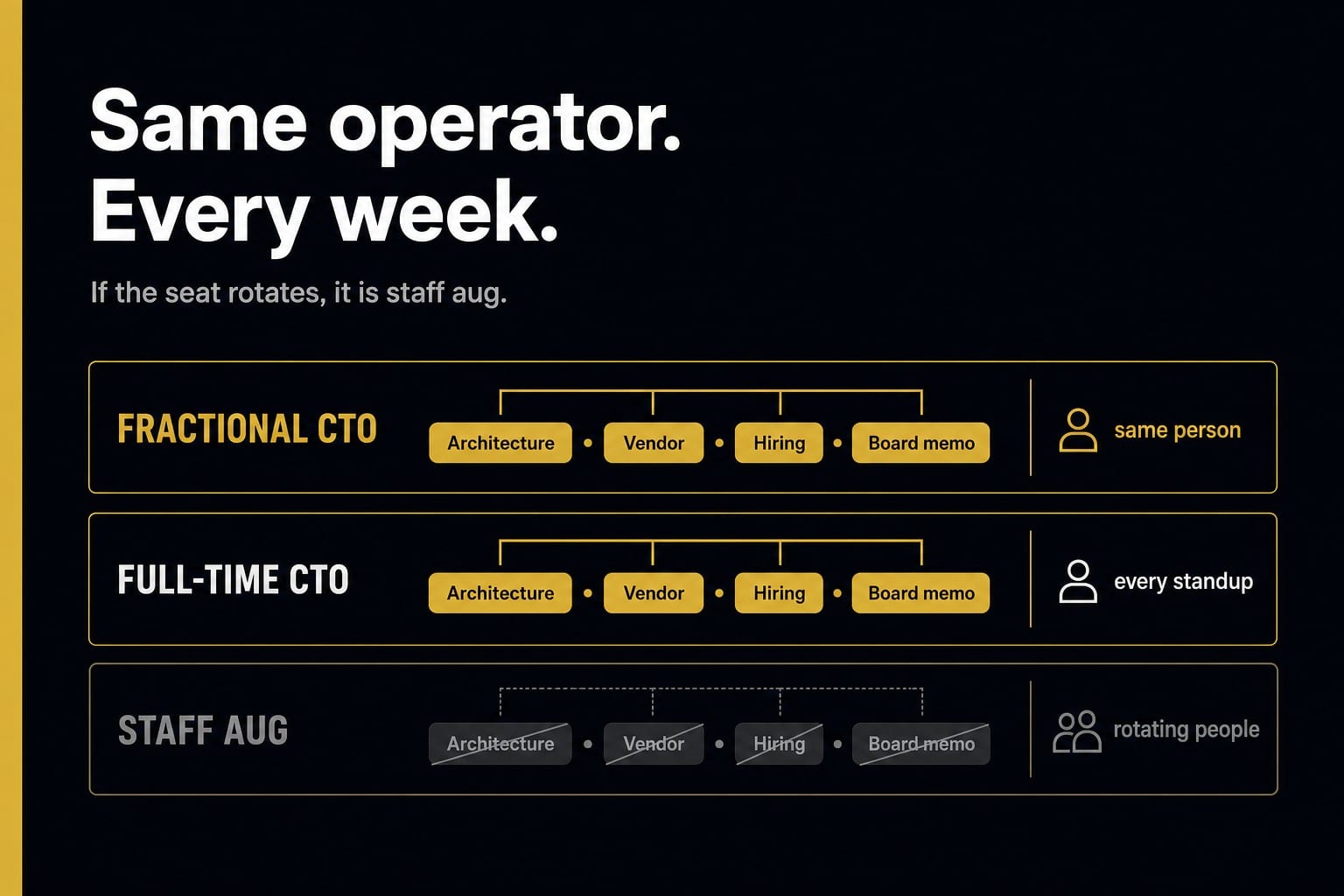
A fractional CTO is the same senior operator week to week. Architecture, vendor, hiring, board-ready tech. No full-time hire. Not a rotating bench.
Fractional CTO for Mid-Market and PE Portcos
PE operating partners, mid-market CEOs, and family offices hire a fractional CTO as the same senior operator week to week for architecture, vendor, hiring, and board-ready technology, without opening a full-time seat. That is not staff augmentation and not a rotating contractor bench.
The retainer is one named person making the CTO-level calls your sitting team cannot close. Build versus buy. Vendor concentration. Who to hire next. What the board hears this month. Engineering managers still run the week.
Here is what that seat actually does. To compare that seat with a fully loaded full-time wage, use the fractional CTO cost calculator.
What a Fractional CTO Actually Does
The published seat is not a report and a handshake. It is the same operator carrying the technology decisions your sitting team cannot close.
Here is what falls under that scope:
Monthly board-ready technology report. What changed, what is blocked, and which decision the CEO, operating partner, or family office needs this month. Outcomes, not architecture diagrams.
Architecture, vendor, and build-or-buy decisions. What to build, what to buy, and what to sunset. Contract review. Partner evaluation. The call that stops a custom build when a vendor already covers the job.
Engineering hiring and technical reference calls. Whether the org can scale. Where leadership, process, or capability is thin. Reference calls on senior hires so you are not buying a title.
Integration and modernization oversight. Post-close integration, core-system modernization, and the sequence that keeps delivery moving while the stack changes.
They set the vision and handle the board-level calls. Your engineering managers run day-to-day execution.
This is the services page for the seat. The portfolio shape, one senior operator across several portcos, is further down this page. The hire-versus-retain decision is interim CTO vs full-time CTO. If the open question is AI priorities, governance, data controls, and model choice, and a technology lead is already in the building, the matching seat is a fractional chief AI officer.
When Fractional Makes More Sense Than Full-Time
Not every company needs a full-time CTO. These are the clearest signals that a retainer is the right move.
You Are Between Growth Stages
You closed a round or a deal. The platform has to handle the next stage of growth. You are not ready to lock a permanent executive. A fractional leader bridges that gap without a premature hire.
Your Technology Challenges Are Strategic, Not Operational
If the work is architecture, build-versus-buy, vendor concentration, or technical diligence on an add-on, you need judgment. Not someone managing daily standups.
You Have Strong Engineering Managers
When the team can execute and lacks senior direction, a fractional CTO is the missing layer. They set the calls. Your managers run the week.
You Need Continuity, Not a Search
A full-time search is a project. The interim vs full-time guide covers the transition window. The fractional seat is the month-to-month operator while you decide whether a permanent hire is even the right shape.
The Commitment Has to Stay Reversible
A full-time CTO is a permanent executive hire. Fractional CTO is a monthly retainer. You can pause or cancel any month. That is the published Pineapples seat, not a blended market range.
One senior operator across several portcos
A PE operating partner who cannot sit in every stack still needs CTO-level calls on each company: architecture, build versus buy, diligence on the next add-on, and the technology view the board asks for. The portfolio shape is one senior operator carrying those calls across several portcos, usually one or two days on each company in a given week. The same person is there at kickoff, at the integration cutover, and at the quarterly review.
That is a different buy from two neighbors.
Interim CTO. One company, a defined end date, usually to bridge a leadership gap or drive one transformation. Same seniority. Single-company focus. The interim versus full-time guide is that decision.
Part-time staff augmentation. A senior individual contributor who rotates if the fit is wrong and does not carry context from one portco to the next. Useful for capacity. Not a fractional CTO.
The portfolio shape pays off when one operator can reuse the pattern. A buy-and-build platform doing repeated add-ons gets a shared diligence and integration playbook because the same person already ran the last one. Diligence and the first 90 days after close stay with that operator, so findings become integration line items instead of a binder. A founder who is still the de facto CTO gets a peer for architecture calls. An operating partner covering many companies stops being the unpaid CTO of the portfolio.
It does not fit when the engineering team needs someone in standup every day. That is a full-time hire or a VP of engineering. It does not fit when the founder is still the right person to make the technology calls, when the seat is also asked to build tools for the PE firm itself, or when a strong sitting CTO is already shipping. In that last case, run a CTO assessment before you add a second leader.
What the seat is paid to produce on a portfolio: architecture calls that scale, senior hiring, diligence on add-ons, the first 90 days after close, the delivery cadence the board is asking about, vendor rationalization that does not break delivery, and a quarterly technology memo. It is not paid to run standups, code review, ticket triage, or on-call. If the work drifts there, hire an engineering manager and put the fractional scope back on decisions.
Screen for an owner-operator, mid-market experience, a personal history of running technology integration, the same person on the engagement, and references from operating partners. "The team will be staffed by" is staff augmentation.
What a Good Engagement Looks Like
The best fractional CTO relationships follow a predictable pattern:
Month 1: Assessment. Deep dive into the current technology landscape. Interviews with engineering leads, product, and the people who actually own the P&L. Deliverable: a written assessment with prioritized recommendations.
Months 2 through 3: Quick wins and roadmap. Address the urgent issues (security gaps, architectural bottlenecks, team structure) while building a 12-month technology roadmap tied to business objectives.
Months 4 through 6: Execution oversight. Guide the first major initiatives on that roadmap. Metrics, review cadence, and reporting that will outlast the engagement.
Ongoing: Advisory. Many companies move from the active retainer to a lighter advisory seat. Board prep, the next vendor call, the next hire. Same operator. Fewer hours.
If the file is a PE portco, the section above is the multi-portco shape. If you need the financial case without inventing a salary model, start with fractional CTO rates and then come back to this page for the seat itself.
The 5 Most Common Mistakes
After 26 years with mid-market, PE, and family-office operators, these are the patterns that fail.
1. Hiring a Fractional CTO to Write Code
If you need hands on keyboards, hire a senior engineer. A fractional CTO who spends the week coding is not doing the job you hired.
2. No Clear Decision-Making Authority
The fractional CTO recommends a new cloud provider. Your VP of Engineering disagrees. Your CEO does not want to pick sides. Nothing happens. Define authority before the retainer starts.
3. Treating It as a One-Time Audit
A technology assessment is useful. The value is sustained judgment. Companies that hire a fractional CTO for a single report rarely see lasting change.
4. Expecting Them to Manage Your Team
Fractional CTOs influence through strategy and mentorship. They should not attend every standup or approve every pull request. If you need a hands-on engineering manager, hire one.
5. Ignoring Cultural Fit
Your fractional CTO will talk to the board, the engineering team, and the product org. If they cannot communicate across those rooms, the technical skill does not matter.
How to Evaluate Fractional CTO Providers
When you compare fractional CTO services, ask these questions:
What industries have they sat in? Mid-market financial services is a different job than mid-market healthcare. A PE portco is a different job than a founder-led family business. Industry context matters.
Can they show named outcomes? Ask for specifics you can verify. Avoid providers who only talk in abstractions.
What does the transition plan look like? The best fractional CTOs build systems that work without them. Ask how they plan to make themselves unnecessary, or how they will hire their replacement.
How do they handle disagreements with your team? You want someone who builds consensus. Not someone who overrides the sitting team by default.
Who shows up next month? Owner-led means the same operator. A bench that rotates is staff augmentation with a nicer title. When the buy is the product itself, week to week, that seat is an AI-native retainer.
What is the published price? Pricing depends on scope. Talk to us.
What the Seat Is For
Mid-market and PE operators hire this seat for three jobs:
Faster decisions. Technology choices that stall in committee get a named owner. The ROI page is the longer financial case.
Less wasted spend. Unused licenses, the wrong vendor tier, and a build you did not need. A fractional CTO is there to kill that work, not to add another tool.
A cleaner hire later. When you do hire full-time, the role, the expectations, and the org shape are already written. You hire for a job. Not a vague title. A CTO assessment is the PE version of that read before you keep or replace a sitting leader.
When to Move to Full-Time
Fractional works until it does not. These are the signals you have outgrown the model:
- Technology is the primary competitive advantage and needs daily executive attention
- You are running multiple product lines and the sitting managers need a permanent executive above them
- Regulatory or board requirements demand a named, full-time technology officer
- The retainer is consistently overflowing because the work is now an operating job
Plan the transition. Do not wait until the seat is already broken. The best fractional CTOs help you hire their replacement.
Getting Started
If you are a PE operating partner, a mid-market CEO, or a family office evaluating a fractional CTO, start here:
-
Write down the technology pain. Not the wish list. What is broken, what is slow, and what the board keeps asking.
-
Define the scope. Strategy only? Strategy plus hiring? Strategy plus vendor and integration? The clearer the scope, the better the fit.
-
Talk to references in your size and industry. Ask what worked and what did not. Ask who actually showed up after month two.
The right fractional CTO does not just clear the current backlog. They leave a foundation the next stage of growth can run.
Pineapples has provided fractional CTO services and technology leadership to mid-market, PE, and family-office operators since 2000. The published seat depends on scope. See PE engagements or talk to us.
Related reading
Frequently asked questions
What is a fractional CTO?
A fractional CTO is a senior technology operator who owns architecture, vendor, hiring, and board-ready technology decisions on a monthly retainer. Same person week to week. PE operating partners, mid-market CEOs, and family offices hire this seat when they need CTO-level calls without a full-time hire.
How much does a fractional CTO cost?
Pineapples prices Fractional CTO. The seat is month-to-month. You can pause or cancel anytime. That is the published retainer, not a blended hourly guess.
What does a fractional CTO do for a mid-market or PE-backed company?
The seat covers a monthly board-ready technology report, architecture and build-or-buy calls, vendor decisions, engineering hiring and technical reference calls, and integration or modernization oversight. Day-to-day standups stay with your engineering managers. The fractional CTO sets the calls those managers execute.
When should a company move from a fractional CTO to a full-time hire?
Move when technology needs daily executive attention as the primary competitive advantage, when a regulator or board requires a named full-time technology officer, or when the retainer is consistently overflowing because the work is now an operating job. Plan the transition. A good fractional CTO helps define the role and hire the replacement.
What is the difference between a fractional CTO and an interim CTO on a PE portfolio?
A fractional CTO splits time across several portfolio companies and carries the strategic technology decisions across them. An interim CTO focuses on one company for a fixed window, often to bridge a leadership transition or to drive one transformation. Both use the same seniority. The distinction is ongoing coverage across companies versus one company with an end date.
Written by Anthony Wentzel