
Data Contract Diligence: The Six Handoffs That Decide the First 100 Days

Anthony Wentzel
Founder, Pineapples
Data Contract Diligence: The Six Handoffs That Decide the First 100 Days
A buyer can diligence the stack, approve the integration budget, close the acquisition, and still lose the first board cycle to a simpler problem.
Nobody agrees what the numbers mean.
The CRM says a customer is active. Billing says the account is past due. Product usage is recorded at the workspace level. Finance reports at the legal-entity level. Support has the real service tier in a custom field. Identity permissions are correct only because one administrator knows the exceptions.
None of this looks like a major technology risk in a system inventory. The applications exist. The exports work. The APIs are available. The integration plan says the data will move.
The missing diligence question is different:
Which business handoffs already have a trusted data contract, and which ones only work because the old team knows the workaround?
A data contract is the operating agreement behind a field or handoff. It defines what the field means, where it comes from, who owns it, when it updates, what happens when it is missing, and which workflow breaks if it is wrong.
Mid-market companies rarely document these contracts formally. They live in habits, spreadsheets, dashboards, ticket tags, and Slack explanations. That is fine while the company is standalone. It becomes expensive when a buyer needs clean reporting, customer continuity, and integration speed at the same time.
This is why a strong pre-acquisition technology assessment should include data-contract testing before close, not as a cleanup project after the first reporting miss.
The Data Contract Map Buyers Should Build
Do not start with every field in every system. That turns diligence into theater.
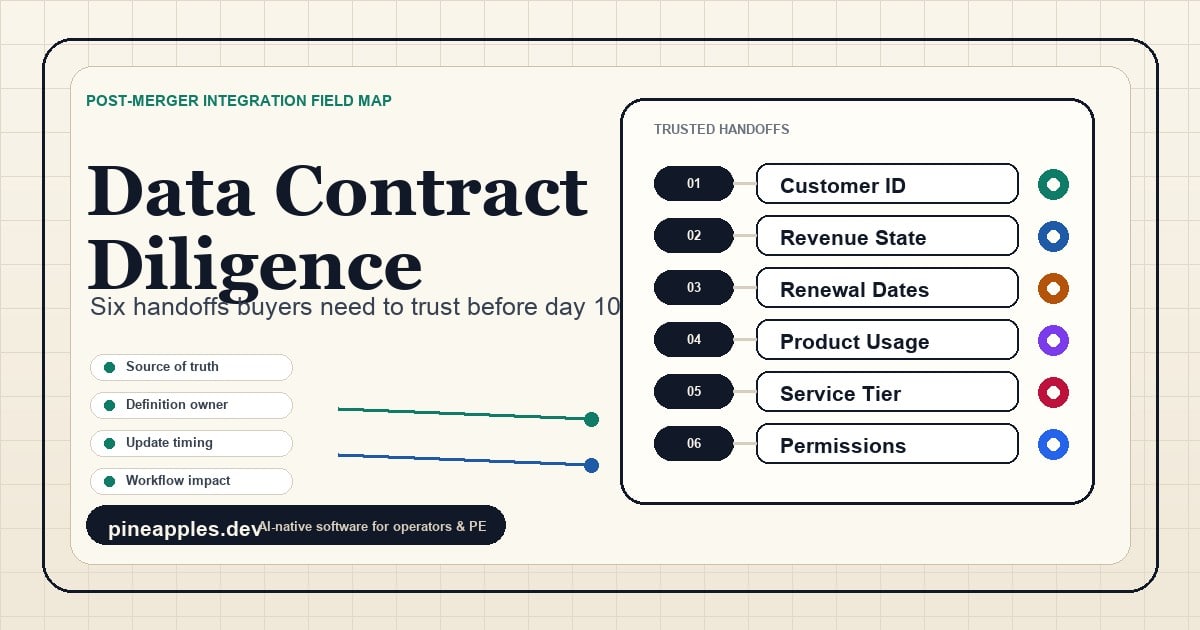
Start with the six handoffs that carry the most operating risk in the first 100 days.
- Customer identity
- Revenue status
- Renewal and contract dates
- Product usage
- Support tier and service promises
- Roles, permissions, and account ownership
For each handoff, ask the same four questions:
- What is the authoritative source?
- Who owns the definition?
- How often does it update?
- What operational decision depends on it?
If the answers are clear, the buyer can plan integration with more confidence. If the answers vary by department, the buyer has found work that belongs in the deal model.
1. Customer Identity
Customer identity is the first contract because every other contract depends on it.
A target may have one customer in the CRM, a different customer entity in billing, multiple workspaces in the product, and several account names in support. Each system can be internally consistent while the combined view is wrong.
The diligence test is simple: take a sample of high-value customers and trace them across CRM, billing, product, support, finance, and identity. Look for duplicate accounts, parent-child confusion, acquired subsidiaries, name changes, legacy IDs, and manually maintained crosswalks.
The risk is not only reporting cleanliness. Customer identity determines who receives renewal outreach, which users keep access, how support routes tickets, how revenue is attributed, and whether the buyer can see concentration risk.
If the target cannot produce a reliable customer map, the buyer should not treat integration as a connector problem. It is a master-data workstream.
2. Revenue Status
Revenue status sounds obvious until every team uses a different definition.
Sales may call an account active after signature. Billing may call it active after invoice. Finance may call it active after recognition begins. Product may call it active after first usage. Customer success may call it active after onboarding.
All five definitions may be reasonable. Only one can drive a combined operating dashboard.
Before close, buyers should ask how the target defines active, paying, contracted, live, suspended, churned, renewed, and expanded. Then they should compare those definitions to the reports the board and operating team will use after close.
This review pairs closely with post-merger integration deferred revenue surprises, but it is not the same problem. Deferred revenue asks what the company still owes. Revenue status asks which customer state the business is allowed to trust when making operating decisions.
If the buyer does not settle that contract early, the first 100 days can become a debate about whose dashboard is real.
3. Renewal and Contract Dates
Renewal dates look like clean fields. They often are not.
One system may hold the legal renewal date. Another may hold the billing anniversary. Customer success may track the practical renewal motion. Sales may use a forecasted close date. Finance may use a service-period end date.
That difference matters when the value-creation plan depends on retention, price increases, packaging changes, or customer consolidation.
A useful diligence sample includes:
- largest renewals in the next two quarters
- customers with amendments
- customers with manual concessions
- customers that changed product mix
- customers on legacy plans
For each one, trace the renewal date from contract to CRM to billing to customer-success workflow. If the dates do not reconcile, the buyer should assume renewal operations need cleanup before any system migration.
4. Product Usage
Usage data is powerful because it seems objective.
It is also easy to misunderstand.
A target may show strong usage while mixing trial users, internal admins, dormant seats, automated events, workspace activity, and account-level reporting. The product team may know the caveats. The buyer may not.
If usage supports the deal thesis, diligence should test the event definitions behind the metric. Ask what counts as an active user, what counts as meaningful usage, whether events tie to paying accounts, how bot or admin activity is excluded, and which product data is safe enough for revenue or retention decisions.
This matters especially when the buyer plans to use product-led expansion, usage-based pricing, customer health scoring, or portfolio reporting. A dirty usage contract does not just create analytics rework. It changes how the buyer understands customer value.
5. Support Tier and Service Promises
Support systems often hold the promises that never made it into the integration model.
A customer may have premium support, special response times, custom escalation paths, migration commitments, training credits, or executive-sponsor promises. Some are in contracts. Some are in ticket tags. Some are in notes. Some are remembered by one account manager.
The buyer should sample customers by revenue, strategic importance, and ticket volume. Then trace support tier from contract to support system to customer-success notes to billing entitlements.
The question is not whether the support tool can migrate. The question is whether the acquired company can prove what service level each customer believes they bought.
If not, integration can create customer friction even when the technical cutover succeeds.
6. Roles, Permissions, and Account Ownership
Permissions are usually treated as a security or IT concern. In integration, they are also an operating continuity concern.
The buyer needs to know who can administer accounts, approve billing changes, access sensitive data, manage integrations, export reports, and receive operational notifications. If those roles are inconsistent, the integration team can create access issues, support spikes, audit gaps, and customer frustration.
Diligence should inspect role definitions, admin exceptions, shared accounts, dormant users, SSO readiness, customer-owned domains, and internal account ownership. This is where a general technology due diligence checklist should become specific enough to test actual permission data, not just ask whether identity systems exist.
How to Turn the Map Into a Deal Decision
The output should not be a long data-governance memo. It should be a short operating-risk map.
For each of the six handoffs, classify the contract:
- Trusted: definition, source, owner, update timing, and downstream use are clear
- Usable with controls: the field works, but needs reconciliation or manual checks during integration
- Untrusted: teams disagree, source of truth is unclear, or critical workflows depend on undocumented cleanup
Then attach the result to the integration plan.
Trusted contracts can move quickly. Usable contracts need temporary controls. Untrusted contracts need budget, owners, and sequencing before the buyer relies on combined reporting.
That is the important distinction. The buyer does not need perfect data before close. The buyer needs to know which data is safe enough to operate and which data needs explicit cleanup before it touches board reporting, customer communication, billing, retention motions, or system cutovers.
The First-100-Day Test
The cleanest way to evaluate data contracts is to ask what the business must do in the first 100 days.
Can leadership produce one customer list?
Can finance explain revenue status without manually reconciling three systems?
Can customer success see renewal risk before it becomes churn?
Can product usage support the investment thesis?
Can support honor service promises after account migration?
Can identity changes happen without creating access issues?
If the answer is no, the buyer has found integration work that should be planned before signing.
The goal is not to make data perfect. The goal is to avoid automating ambiguity.
When buyers skip this step, system integration looks successful right up until the business tries to make a decision. When they run it before close, the integration plan gets sharper: fewer surprises, clearer owners, better sequencing, and a first board cycle built on numbers the team can defend.
That is the real diligence win. Not proving that the systems can connect. Proving that the combined company can trust the handoffs that make the investment thesis operational.
Frequently asked questions
What is a data contract in the context of post-merger integration?
A data contract is the operating agreement behind a field or handoff between business systems. It defines what a field means, where it comes from, who owns it, when it updates, what happens when it is missing, and which workflow breaks if it is wrong. Mid-market companies rarely document these contracts formally, which makes them a hidden integration risk after an acquisition closes.
Which data handoffs carry the most risk in the first 100 days after a deal closes?
The six highest-risk handoffs are customer identity, revenue status, renewal and contract dates, product usage, support tier and service promises, and roles and permissions. Each one can appear clean in a system inventory while actually depending on undocumented workarounds that only the prior team understands. Buyers who map these six before close avoid the most common first-board-cycle reporting failures.
How should a buyer classify data contract risk during technology due diligence?
The post recommends a three-level classification for each of the six handoffs: trusted (definition, source, owner, and update timing are all clear), usable with controls (the field works but needs reconciliation or manual checks during integration), and untrusted (teams disagree or critical workflows depend on undocumented cleanup). Trusted contracts can move quickly in integration, while untrusted ones need explicit budget, owners, and sequencing before they touch board reporting or customer communications.
Why do revenue status definitions cause problems after an acquisition?
Different teams inside the same company often use different definitions for the same status terms. Sales may call an account active after signature, billing after invoice, finance after recognition begins, product after first usage, and customer success after onboarding. All five definitions can be internally reasonable, but only one can drive a combined operating dashboard. If buyers do not settle that contract early, the first 100 days can become a debate about whose numbers are real rather than a focus on value creation.
Working a live deal?
Book a 30-minute working session.
Same operator who runs the diligence engagements. No SDRs, no sales team. Bring the target, I'll bring the checklist.
Share this article
Anthony Wentzel
Founder, Pineapples
Anthony has spent 26 years helping operators and investors translate technology risk into business decisions, especially when acquisitions hinge on fast integration and credible value creation.