
Product Strategy
Product Roadmap Consulting for Mid-Market Companies: How to Build a Roadmap That Actually Ships
Published Mar 26, 2026. Updated Oct 11, 2026
What a product roadmap consultant does, what it costs (for a 4 to 6 week engagement), and when mid-market teams should build it in-house.
Product Roadmap Consulting for Mid-Market Companies: How to Build a Roadmap That Actually Ships
A product roadmap consultant fixes a roadmap that has turned into a political wish list. They interview engineering, sales, customer success, leadership, and customers, set a prioritization framework, build a now, next, and later roadmap around real capacity and dependencies, then run the reviews that keep leadership on it. A one-time engagement typically takes 4 to 6 weeks.
Your product roadmap has 47 items on it. Engineering says they can deliver 12 this quarter. Sales wants 20. The CEO just came back from a conference and added three more.
This is the reality for most mid-market companies. The roadmap becomes a political document instead of a strategic one. Features get prioritized by whoever yells loudest, not by what moves revenue.
Product roadmap consulting exists to fix this. But most companies either don't know it exists or confuse it with hiring a product manager. The two are not the same.
Why Mid-Market Companies Struggle With Roadmaps
Small companies don't need formal roadmaps. The founder decides what to build, and three engineers build it. Enterprise companies have entire product organizations with VPs, directors, and analysts.
Mid-market companies sit in the gap. They have enough complexity to need a real roadmap but rarely have the product leadership to build one well.
The Usual Failure Modes
The Feature Factory. Engineering ships constantly but nothing moves the needle. Features get built because customers asked, not because they solve a strategic problem. Twelve months later, the product is bloated and retention is flat.
The Executive Wish List. The roadmap is whatever the CEO or board wants. No validation, no sequencing, no trade-off analysis. Engineering burns cycles on pet projects while competitors ship what users actually need.
The Consensus Trap. Every stakeholder gets a vote. The roadmap becomes a compromise that satisfies nobody. High-impact items get delayed because they require saying no to someone important.
The Technical Debt Spiral. Engineering keeps asking for "infrastructure time" but can never quantify the ROI. Product keeps pushing features. Eventually the codebase becomes so fragile that every release takes twice as long.
What Product Roadmap Consulting Actually Looks Like
Good product roadmap consulting is not someone showing up with a template and a Gantt chart. It is a structured process for making better decisions about what to build and when.
Phase 1: Discovery (Weeks 1-2)
The consultant talks to everyone: engineering leads, sales, customer success, the CEO, and actual customers. The goal is not to gather feature requests. It is to understand:
- What is the company's growth model? (PLG, sales-led, expansion revenue)
- Where are users dropping off?
- What does engineering actually spend time on? (features vs bugs vs debt vs toil)
- What are the next 2-3 revenue milestones?
This phase almost always reveals that leadership has fundamentally different assumptions about what the product should become. Getting those assumptions on the table is worth the entire engagement.
Phase 2: Prioritization Framework (Week 3)
Every company needs a scoring system, but the system has to match the business. A B2B SaaS company with 80% of revenue from 10 accounts needs a different framework than one with 2,000 SMB customers.
Common approaches:
- RICE scoring (Reach, Impact, Confidence, Effort) for balanced prioritization
- ICE scoring (Impact, Confidence, Ease) for speed-focused teams
- Weighted scoring with custom dimensions (revenue impact, retention impact, strategic alignment, technical risk)
The framework matters less than the discipline of using it consistently. The consultant's job is to pick the right one and get buy-in from leadership.
Phase 3: Roadmap Architecture (Weeks 3-4)
This is where most internal attempts fail. Building the actual roadmap requires:
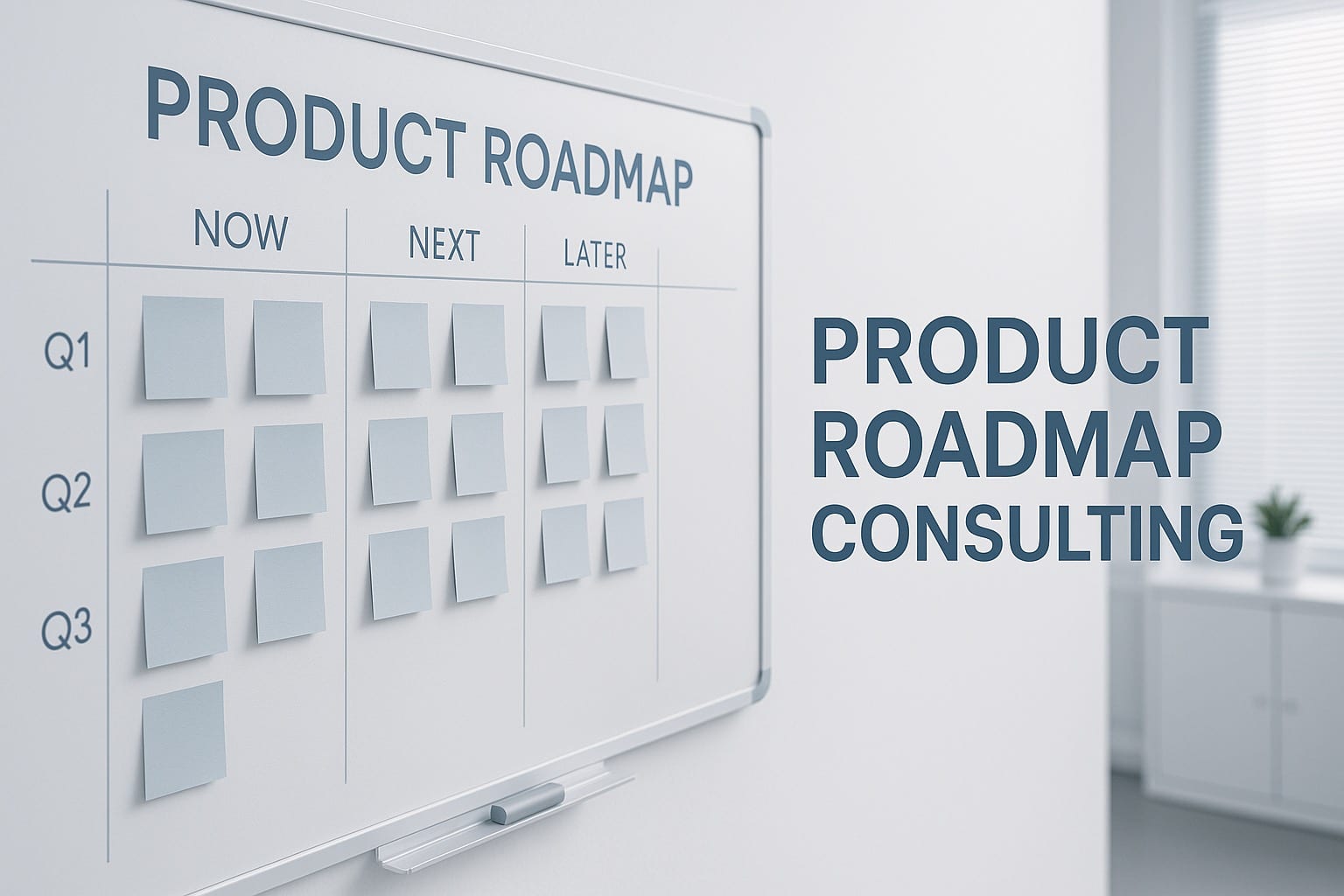
Time horizons. Now (this sprint), Next (this quarter), Later (this half). Anything beyond 6 months is a guess and should be labeled as such.
Themes, not features. "Improve onboarding" is a theme. "Add a progress bar to step 3" is a feature. Roadmaps should communicate themes to leadership and break down into features for engineering.
Dependencies mapped. That new analytics dashboard requires the data pipeline refactor. The mobile app launch depends on the API redesign. These connections are invisible until someone maps them.
Capacity planning. How many engineers are available? What percentage goes to maintenance vs new features? What is the realistic velocity? Most roadmaps assume 100% of engineering time goes to new features. The real number is closer to 60%.
Phase 4: Alignment and Adoption (Week 4+)
The best roadmap in the world is useless if nobody follows it. The consultant facilitates alignment sessions with leadership, creates a review cadence, and builds the muscle for ongoing prioritization.
This usually means:
- Monthly roadmap reviews with the executive team
- Quarterly re-prioritization based on results
- A clear escalation path for new requests (instead of "just add it to the backlog")
- Metrics tied to roadmap themes (not just feature completion)
What the client holds at the end of each phase:
- Phase 1, discovery (weeks 1 to 2): a discovery readout. Growth model, where users drop off, where engineering time goes, and the next revenue milestones, with the disagreements written down.
- Phase 2, prioritization (week 3): the scoring framework leadership agreed to use.
- Phase 3, roadmap architecture (weeks 3 to 4): the roadmap. Now, next, and later themes, the dependencies, and a capacity split engineering can staff.
- Phase 4, alignment (week 4 on): an alignment plan. The review cadence, the escalation path for new requests, and metrics tied to themes.
How to Evaluate a Product Roadmap Consultant
Green Flags
- They start by talking to customers, not just leadership
- They push back on pet projects with data
- They have experience in your business model (B2B, PLG, marketplace)
- They care about adoption, not just the deliverable
- They can speak both business and engineering
Red Flags
- They lead with tools (Jira, Productboard, Aha!) instead of strategy
- They promise a "complete roadmap" in two weeks
- They have no engineering background and cannot assess technical feasibility
- They treat the engagement as a one-time deliverable instead of a capability transfer
The Cost Question
Mid-market product roadmap consulting typically runs:
- One-time engagement. 4 to 6 weeks. Best when the company needs a roadmap and a way to keep using it.
- Workshop. 2 to 3 days. Best when leadership needs the tradeoffs on the table fast.
- Fractional product leadership. Monthly. Best when the team needs the same product owner after the roadmap exists.
After the engagement, ongoing product leadership on retainer is the seat if you are not ready to hire a full-time VP of Product.
The ROI calculation is straightforward. If your engineering team is 20 people at a loaded cost of $200K each, that is $4M/year. Improving their output by 20% through better prioritization is worth $800K. A consulting engagement that achieves that pays for itself.
When to Hire a Consultant vs Build Internal Capability
Hire a consultant when:
- You have never had formal product leadership
- Engineering and sales are constantly at odds over priorities
- You are about to raise a round and need a credible product strategy
- You have a new product line and need to sequence the build
Build internally when:
- You have a stable product with predictable growth
- Your team already practices good prioritization but needs a dedicated owner
- You are large enough to justify a full-time VP of Product ($250K+)
Most mid-market companies start with a consultant, learn the process, then hire internally once they know what good looks like.
Getting Started
The first step is not finding a consultant. It is getting honest about where your roadmap process is broken.
Ask your engineering lead: "What percentage of what we shipped last quarter directly moved a revenue metric?" If the answer is below 50%, you have a prioritization problem.
Ask your sales team: "What do you promise prospects that we don't actually have?" If the list is long, you have an alignment problem.
Ask your CEO: "Can you describe our product strategy in one sentence?" If the answer takes five minutes, you have a clarity problem.
Any of those signals mean product roadmap consulting will pay for itself quickly. The companies that win in mid-market are not the ones with the most features. They are the ones that build the right features in the right order.
Pineapples helps mid-market companies build product roadmaps that ship. Talk to us about your product strategy.
Frequently asked questions
What does a product roadmap consultant actually do?
A product roadmap consultant runs a structured process to help companies decide what to build and in what order. This typically includes a discovery phase with engineering, sales, and customers, followed by building a prioritization framework and roadmap architecture, and then facilitating leadership alignment and a review cadence. The goal is to turn a political wish list into a strategic plan that engineering can actually execute.
How much does product roadmap consulting cost for a mid-market company?
A one-time engagement running four to six weeks typically costs. Workshop formats of two to three days run. Ongoing fractional product leadership, for companies that need a sustained capability, generally runs. The ROI case is straightforward: better prioritization across a 20-person engineering team can redirect hundreds of thousands of dollars of capacity toward higher-impact work.
When should a mid-market company hire a product roadmap consultant versus building the capability in-house?
A consultant makes sense when the company has never had formal product leadership, when engineering and sales are constantly at odds over priorities, or when an upcoming fundraise requires a credible product strategy. Building internally makes more sense when the product is stable, when prioritization is already working well and only needs a dedicated owner, or when the company is large enough to justify a full-time VP of Product. Most mid-market companies start with a consultant to learn what good looks like, then hire internally.
What are the warning signs that a product roadmap process is broken?
Three quick diagnostics can surface the problem fast. First, ask your engineering lead what percentage of last quarter's shipped work directly moved a revenue metric: if the answer is below 50 percent, the team has a prioritization problem. Second, ask sales what they promise prospects that the product does not actually have: a long list signals an alignment gap. Third, ask the CEO to describe the product strategy in one sentence: if the answer takes five minutes, the company lacks strategic clarity.
How do you prioritize a product roadmap?
When features get prioritized by whoever yells loudest, the fix is a scoring system that matches the business. RICE (reach, impact, confidence, effort) suits balanced prioritization, ICE (impact, confidence, ease) suits speed-focused teams, and weighted scoring adds dimensions such as revenue impact, retention impact, strategic alignment, and technical risk. The framework matters less than using it consistently, with leadership bought in.
What makes a good product roadmap?
A good roadmap is one engineering can actually deliver. It uses time horizons (now, next, later) and labels anything beyond six months as a guess. It shows themes to leadership and breaks them into features for engineering. It maps dependencies, and it plans capacity honestly: most roadmaps assume all engineering time goes to new features, when the real share is closer to 60%.
How do you communicate a product roadmap?
A roadmap nobody follows is useless, so communication is part of the work, not an afterthought. Show leadership themes, such as improving onboarding, and give engineering the features underneath. Hold monthly roadmap reviews with the executive team, re-prioritize quarterly based on results, and give new requests a clear escalation path instead of dropping them into the backlog. Tie metrics to themes, not feature completion.
How do you use customer feedback in a product roadmap?
Customer feedback should explain problems, not dictate features. Teams that build whatever customers ask for end up with a feature factory: constant shipping, a bloated product, and flat retention. Talk to actual customers during discovery to learn where users drop off and what would move the next revenue milestones, then score those problems with the same prioritization framework as every other request.
Written by Anthony Wentzel