
Engineering Leadership
SaaS Development Company: How Mid-Market Buyers Choose
Published Mar 25, 2026
How mid-market buyers choose a SaaS development company in 2026: seven criteria, from multi-tenant builds and billing to SOC 2 and post-launch support.
SaaS Development Company: How Mid-Market Buyers Choose
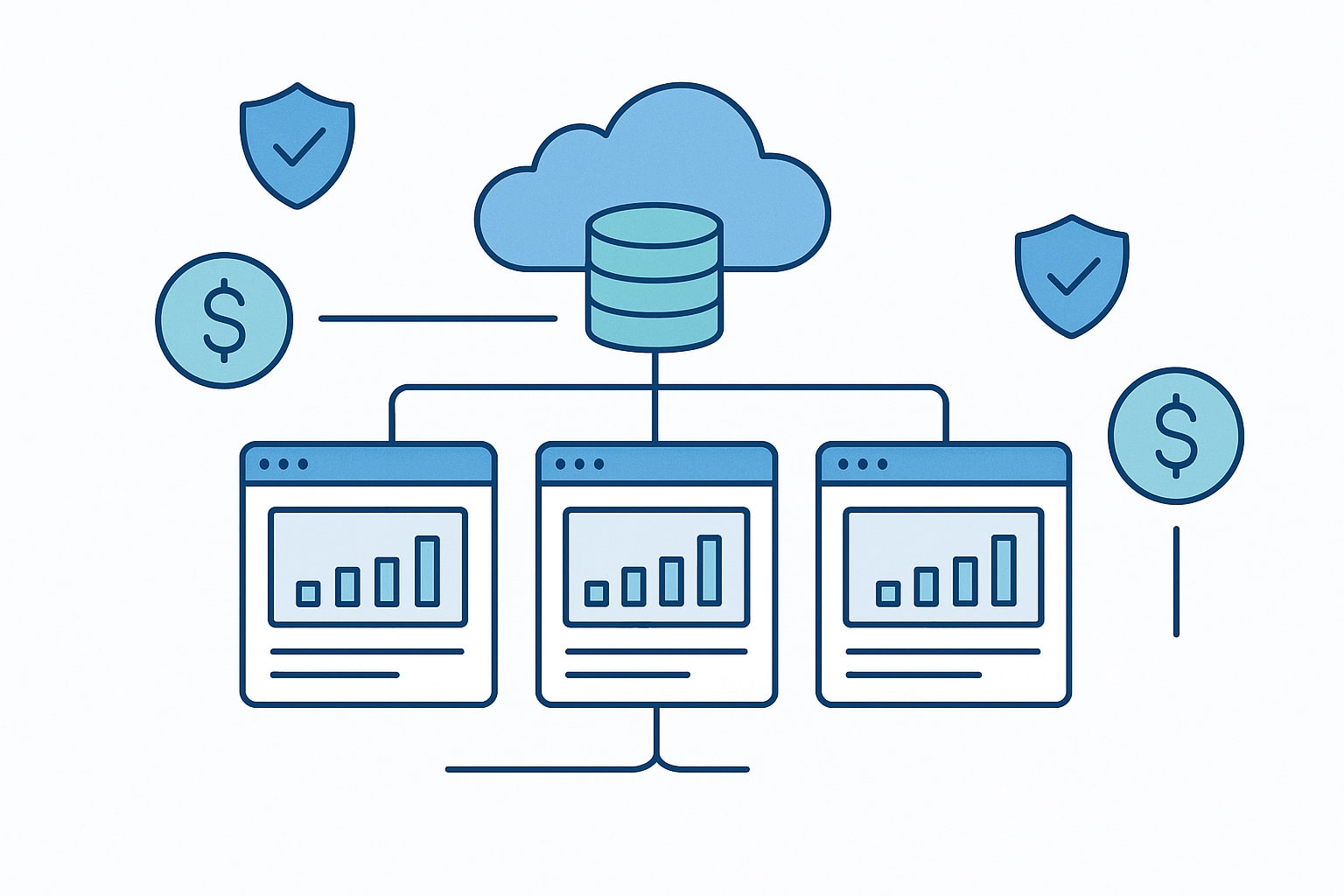
Seven criteria to check before you hire. Each one matches a section below.
- Have they built and launched multi-tenant products before?
- What is their architecture decision process?
- How do they handle security and compliance?
- What does their team structure look like?
- What is their post-launch support model?
- How do they price engagements?
- Can they help you scale after launch?
A SaaS development company builds multi-tenant, cloud-native products that many customers use from a single codebase. Shared infrastructure, subscription billing, and self-service onboarding are part of that product. A custom software shop builds a one-off application for a single client. If a vendor proposes a separate deployment for each of your customers, they are building custom software, not SaaS.
I write this for PE operating partners, portfolio-company CTOs, family-office operators, and mid-market founders. You already chose build over buy. You need a partner who ships tenant isolation, billing, and onboarding, then leaves a sitting team able to run the product without a permanent dependency.
The questions below separate that partner from a custom shop. First, why mid-market companies build these products at all.
Why Mid-Market Companies Build SaaS Products
Before evaluating partners, it helps to understand why mid-market teams increasingly build their own SaaS platforms instead of relying on off-the-shelf tools:
- Vertical expertise becomes a product. Companies with deep domain knowledge monetize it by packaging workflows into software their customers pay for monthly
- Internal tools outgrow spreadsheets. What started as an internal process becomes valuable enough to sell externally
- Competitive moats require custom software. When every competitor uses the same Salesforce plugins, your proprietary platform becomes the differentiator
- Revenue diversification. Recurring SaaS revenue provides predictability that project-based revenue cannot match
- AI capabilities need custom infrastructure. Off-the-shelf tools rarely support the kind of AI-powered workflows mid-market teams want to embed in their products
The shift is clear: mid-market companies are becoming software companies, whether they planned to or not.
What a SaaS Development Company Actually Delivers
Not every software development shop can build SaaS products. The architecture, security model, and operational requirements are fundamentally different from building a one-off web application.
Here is what a genuine SaaS development company should bring to the table:
Multi-Tenant Architecture
The foundation of any SaaS product is multi-tenancy, the ability to serve multiple customers from a single codebase while keeping their data isolated.
A competent partner will:
- Design tenant isolation at the database level (schema-per-tenant, row-level security, or separate databases depending on your compliance requirements)
- Implement tenant-aware middleware that routes requests correctly from the first HTTP call
- Build configurable feature flags so you can roll out capabilities per-tenant or per-plan
- Handle data partitioning strategies that work at 10 customers and still work at 10,000
Red flag: If a company proposes building separate deployments for each customer, they are building custom software, not SaaS. Walk away.
Multi-tenant analytics and row-level security
Some products also embed analytics that each customer sees inside the app. Isolation has to hold in that layer, not only in the application database. The database options on this page are schema-per-tenant, row-level security, or a separate database. Ask which of those the analytics layer uses, and whether a chart can run with a credential that sees every tenant. If the only filter is a tenant id the browser sends, that is not row-level security. Ask this before you sign.
Subscription and Billing Infrastructure
SaaS products live and die by their billing systems. Your development partner should have hands-on experience with:
- Stripe Billing, Chargebee, or equivalent for subscription management, proration, and dunning
- Usage-based pricing models (metered billing, seat-based, hybrid), not just flat monthly plans
- Trial and onboarding flows that minimize friction from signup to first value
- Invoice generation and tax compliance across jurisdictions (especially if you sell B2B across states or countries)
Authentication and Authorization
SaaS security is not optional. Mid-market buyers will ask about it during procurement, and enterprise customers will require SOC 2 before signing.
Look for partners who implement:
- SSO via SAML and OIDC, not just social login. Your customers' IT teams will demand it
- Role-based access control (RBAC) with organization-level and team-level granularity
- API key management for integrations and developer access
- Audit logging that captures who did what, when, and from where
Infrastructure and DevOps
A SaaS product is not "done" when the features ship. It runs 24/7, and your development partner should design for that from day one:
- Infrastructure-as-code (Terraform, Pulumi, or CDK) so environments are reproducible
- CI/CD pipelines that deploy to staging and production with automated tests
- Monitoring and alerting via Datadog, Grafana, or equivalent, not just "we'll check the logs"
- Auto-scaling configurations that handle traffic spikes without manual intervention
- Database backup and disaster recovery with tested restore procedures
The 7-Point Evaluation Framework
Seven questions separate a serious partner from a shop that will waste your budget. Ask them before you sign.
Criterion, what to ask, red flag
- Multi-tenant products shipped. Ask for a SaaS product in production for more than 12 months and how tenant isolation worked. Red flag: case studies that only mention web applications or portals, with no multi-tenancy.
- Architecture decision process. Ask how they choose a monolith or microservices, how schema migrations work in a multi-tenant database, and how they version APIs. Red flag: an architecture proposal that never asks about growth, compliance, or integrations.
- Security and compliance. Ask whether products they built reached SOC 2 Type II, how they encrypt data at rest and in transit, and how penetration testing happens during development. Red flag: security treated as a phase at the end.
- Team structure. Ask who will work on the project and whether the same people handle architecture, development, and deployment. Red flag: a rotating cast of junior developers instead of a consistent team with a technical lead who has built SaaS products.
- Post-launch support. Ask what support includes, what costs extra, who answers a production incident, and what the SLA is for a critical bug. Red flag: time and materials with no defined SLA.
- Pricing model. Ask whether discovery is a fixed phase before a time-and-materials build, a milestone plan, or a monthly retainer. Red flag: one fixed price for the entire build with no discovery.
- Scale after launch. Ask how the proposed architecture handles more usage than year one, and which database and caching choices fit your read and write patterns. Red flag: no answer on caching, read replicas, or queues until you ask.
1. Have They Built and Launched Multi-Tenant Products Before?
This is non-negotiable. Ask for specific examples of SaaS products they have built that are live and serving paying customers.
What to ask:
- "Show me a SaaS product you built that has been in production for more than 12 months"
- "How did you handle tenant isolation in that project?"
- "What was the most complex billing scenario you implemented?"
Red flag: Case studies that only mention "web applications" or "portals" without multi-tenancy signals.
2. What Is Their Architecture Decision Process?
Good SaaS development companies do not jump into code. They start with architecture decisions that affect everything downstream.
What to ask:
- "Walk me through how you would decide between a monolith and microservices for our use case"
- "How do you handle schema migrations in a multi-tenant environment?"
- "What is your approach to API versioning?"
Green flag: They ask about your growth projections, compliance requirements, and integration needs before proposing an architecture.
3. How Do They Handle Security and Compliance?
For B2B SaaS serving mid-market or enterprise customers, security is table stakes.
What to ask:
- "Have you built products that achieved SOC 2 Type II certification?"
- "How do you implement data encryption at rest and in transit?"
- "What is your approach to penetration testing during development?"
Red flag: They treat security as a phase at the end rather than a design principle throughout.
4. What Does Their Team Structure Look Like?
The team assigned to your project matters as much as the company's portfolio.
What to ask:
- "Who specifically will work on our project, and what is their SaaS experience?"
- "Will the same team handle architecture, development, and deployment?"
- "How do you handle knowledge transfer if a key team member leaves?"
Green flag: They assign a consistent team with a technical lead who has built SaaS products before, not a rotating cast of junior developers.
5. What Is Their Post-Launch Support Model?
Shipping the first version is the smaller share of the work. Operations, iteration, and scaling after launch take the rest.
What to ask:
- "What does your post-launch support include, and what costs extra?"
- "How do you handle production incidents at 2 AM?"
- "What is your SLA for critical bug fixes?"
Red flag: They only offer "time and materials" support with no defined SLAs. That means you are on your own when things break.
6. How Do They Price Engagements?
SaaS development pricing models vary widely. Understanding the structure helps you compare apples to apples.
Common models:
- Fixed-price discovery + T&M build: Best for most mid-market engagements. You get a fixed-cost discovery phase (4 to 6 weeks) that produces an architecture document and backlog, then pay time-and-materials for the build
- Milestone-based: Payment tied to deliverables. Works when scope is well-defined
- Dedicated team (monthly retainer): Best for ongoing development after initial launch. Ongoing product work after launch is often a retainer instead of a project shop
- Revenue share or equity: Rare, but some companies invest in products they believe in
Red flag: A company that quotes a fixed price for the entire build without doing discovery first is either padding heavily or planning to cut corners.
7. Can They Help You Scale After Launch?
Your SaaS product at 100 users has different needs than at 10,000 or 100,000. The right partner thinks about scale from day one.
What to ask:
- "How would the architecture you are proposing handle 10x our projected first-year usage?"
- "What database and caching strategies do you recommend for our read/write patterns?"
- "How do you approach performance optimization as the product matures?"
Green flag: They proactively discuss caching layers, CDN strategy, database read replicas, and queue-based processing without you having to ask.
SaaS Tech Stack Decisions That Matter
The specific technologies matter less than the reasoning behind them. That said, here is what holds up for mid-market SaaS builds in 2026:
| Layer | Recommended Options | Why | |-------|-------------------|-----| | Frontend | Next.js, Remix | SSR for SEO pages + SPA for app dashboard | | Backend | Node.js (NestJS), Python (FastAPI), Go | Depends on team expertise and performance needs | | Database | PostgreSQL with row-level security | Best multi-tenancy support, mature ecosystem | | Auth | Clerk, Auth0, WorkOS | SSO, RBAC, and org management out of the box | | Billing | Stripe Billing, Chargebee | Handles metered, seat-based, and hybrid models | | Infrastructure | AWS, GCP, or Azure with Terraform | Reproducible, scalable, well-documented | | Monitoring | Datadog, Sentry, PostHog | Observability across infra, errors, and product analytics | | CI/CD | GitHub Actions, GitLab CI | Low-friction, well-integrated pipelines |
Important: Be skeptical of any company that mandates a specific stack before understanding your requirements. The best partners recommend based on your constraints, not their preferences.
Common Mistakes Mid-Market Companies Make
Mistake 1: Treating SaaS Development Like Custom Software
Custom software solves one company's problem. SaaS products solve a market's problem. The development process, architecture, and team structure are different.
What goes wrong: You hire a custom development shop that builds a great app for your first customer, but the architecture cannot support multi-tenancy, per-tenant configuration, or self-service onboarding.
How to avoid it: Only evaluate companies with proven SaaS product experience, not just "we can build web apps."
Mistake 2: Skipping Discovery to "Move Fast"
Discovery feels like a delay when you are excited about your product. But skipping it almost always costs more time in the long run.
What goes wrong: The team builds for three months, then discovers that the data model does not support a critical workflow. Rearchitecting burns a large share of the budget you already spent.
How to avoid it: Insist on a 4 to 6 week discovery phase that produces an architecture document, data model, and prioritized backlog before any production code is written.
Mistake 3: Ignoring Operations Until Launch
SaaS products need monitoring, logging, alerting, backup, and incident response from the first deployment, not as a "phase 2" add-on.
What goes wrong: The product launches, gains traction, then crashes during a traffic spike. There is no monitoring to diagnose the issue, no auto-scaling to absorb the load, and no runbook for incident response.
How to avoid it: Require that infrastructure, CI/CD, and monitoring are set up in sprint one, not sprint ten.
Mistake 4: Over-Engineering for Scale You Do Not Have
The opposite extreme is equally dangerous. Building for millions of users when you have 50 burns budget on complexity you do not need yet.
What goes wrong: The team spends six months building a microservices architecture with Kubernetes, event sourcing, and CQRS, and the product has not found product-market fit yet.
How to avoid it: Start with a well-structured monolith that can be decomposed later. A good partner will design the boundaries now and split services only when load requires it.
Mistake 5: Not Planning for Customer Onboarding
The fastest way to kill a SaaS product is a terrible onboarding experience. If customers cannot reach a first useful result soon after signing up, they churn.
What goes wrong: The product has great features but no self-service setup wizard, no data import tools, and no in-app guidance. Every new customer requires a long onboarding call.
How to avoid it: Include onboarding UX in the MVP scope. Self-service signup, guided setup, sample data, and contextual help are not nice-to-haves, they are essential for SaaS growth.
What a Good Engagement Timeline Looks Like
For a mid-market SaaS product going from concept to first paying customers, here is a realistic timeline:
Weeks 1 to 6: Discovery and Architecture
- Stakeholder interviews, user research, competitive analysis
- Architecture decision records (ADRs) for multi-tenancy, auth, billing
- Data model and API contract design
- Prioritized backlog with MVP scope defined
- Infrastructure blueprint and CI/CD setup
Weeks 7 to 18: MVP Build
- Core features built and deployed to staging
- Multi-tenancy, auth, billing, and admin panel functional
- Integration testing across tenant boundaries
- Beta testing with 3 to 5 design partners
Weeks 19 to 22: Launch Preparation
- Performance testing and optimization
- Security audit and penetration testing
- Production deployment with monitoring and alerting
- Customer onboarding flow polished
- Go-to-market support (landing pages, docs, API reference)
Weeks 23+: Growth and Iteration
- Feature development based on customer feedback
- Performance optimization as usage scales
- Compliance certifications (SOC 2 timeline starts here)
- Analytics-driven product improvements
Total MVP timeline: 5 to 6 months. Anyone promising a production-ready SaaS product in less than 3 months is either cutting corners or does not understand the scope.
What to Ask Any SaaS Development Partner
The partner you hire should answer these questions in plain language. The answers show whether they build a product many customers share, or a one-off app.
Does discovery happen before a build quote? Ask for a discovery phase that produces an architecture document and a prioritized backlog before anyone prices the full build. A partner who quotes the build first is guessing at your users, your market, and your constraints.
Do they design for later growth and build for today? Ask how the architecture leaves clear boundaries for future decomposition without over-engineering the MVP. A well-structured monolith with clean service boundaries ships faster and iterates easier.
Is security a design principle from the first sprint? Ask how they implement multi-tenant isolation, encryption, RBAC, and audit logging before features pile up. Ask whether products they have worked on reached SOC 2 Type II, and how penetration testing happens during development.
What continues after launch? Ask who responds to production incidents, how you review performance together, and how feature work continues. A partner who treats launch as the end leaves your team running a system they did not design.
Ready to Build Your SaaS Product?
If you are a mid-market founder, a portfolio-company CTO, a PE operating partner, or family-office ops weighing a SaaS build, start in chat. Bring the product you want customers to pay for and the person who will run it after launch.
Frequently asked questions
What criteria should I use to choose a SaaS development company?
Check seven things: shipped multi-tenant products before, a clear architecture decision process, security and compliance (SOC 2 if you sell to enterprises), team structure, post-launch support, pricing model, and whether they can help you scale after launch.
Can a SaaS development company build row-level security into multi-tenant analytics?
It should be part of the multi-tenant architecture conversation from day one. Ask how tenant data is isolated in the database and in any embedded analytics layer before you sign.
What is a SaaS development company and how is it different from a custom software shop?
A SaaS development company specializes in building multi-tenant, cloud-native products that serve many customers from a single codebase, with shared infrastructure, subscription billing, self-service onboarding, and built-in security controls like RBAC and SSO. A custom software shop typically builds one-off applications for a single client, and their architecture, team structure, and delivery process are not designed for the ongoing operations and tenant isolation that a SaaS product requires. If a vendor proposes building separate deployments for each of your customers, they are building custom software, not SaaS.
How long does it take to build a mid-market SaaS product from concept to launch?
A realistic MVP timeline for a mid-market SaaS product runs 5 to 6 months: roughly 6 weeks of discovery and architecture, 12 weeks of core build, and 4 weeks of launch preparation including performance testing, security audit, and production deployment. Any vendor promising a production-ready SaaS product in under 3 months is either cutting corners or underestimating the scope. The timeline covers multi-tenancy, authentication, billing, monitoring, and a polished onboarding flow, all of which are essential for a product that can acquire and retain paying customers.
What pricing model should I expect when hiring a SaaS development company?
The most common structure for mid-market engagements is a fixed-price discovery phase (typically 4 to 6 weeks) that produces an architecture document and prioritized backlog, followed by time-and-materials billing for the build itself. Milestone-based pricing works when scope is already well-defined, and a monthly retainer model fits ongoing development after initial launch. A company that quotes a single fixed price for the entire build without doing discovery first is either padding the estimate heavily or planning to cut scope when problems arise.
What should I look for in a SaaS development partner if my company needs SOC 2 compliance?
Look for a partner who treats security as a design principle from sprint one rather than a phase at the end. Specifically, they should implement multi-tenant data isolation at the database level, encryption at rest and in transit, role-based access control with org-level granularity, SSO via SAML and OIDC, and audit logging that captures every meaningful user action. Ask directly whether they have helped prior clients achieve SOC 2 Type II certification and how they approach penetration testing during development, not after launch.
Written by Anthony Wentzel