
Engineering Leadership
IT Staff Augmentation: A Seat on a Board You Still Own
Published Mar 21, 2026. Updated Oct 14, 2026
IT staff augmentation adds a person to a team the buyer still runs. The buyer keeps the outcome and still manages the work.
IT Staff Augmentation: A Seat on a Board You Still Own
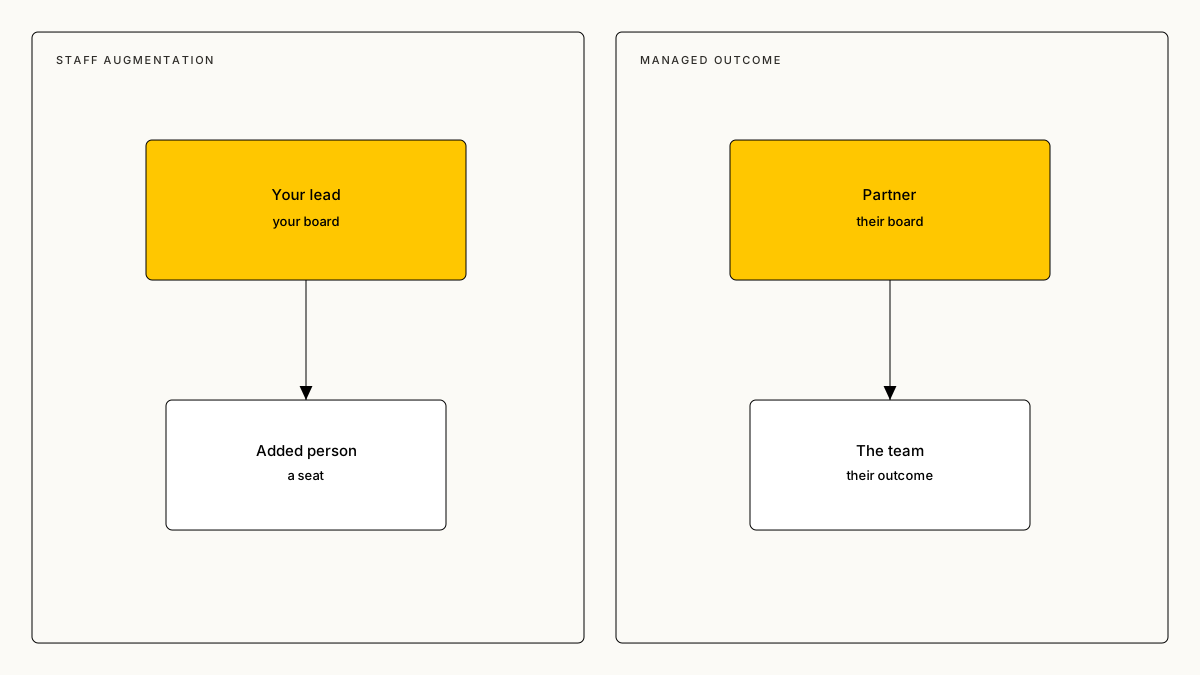
IT staff augmentation is adding a person to a team the buyer still runs. The buyer keeps the board, the architecture, and the outcome. The added person takes a seat inside that team. I use that shape when the object is already named and the missing thing is capacity, not a decision.
The real problem
Delivery slows. The first proposal is a seat. The seat can be a real engineer. The board does not move, because the object was never named. Adding a person to an unnamed object makes a larger meeting.
I will not pretend a file was IT staff augmentation when I cannot say that. The file I can name is an outcome. A $3.4M React Native engagement. Expo plus Expo Router on the web. at.tv and DirecTV shipped from one codebase. The second brand is a theme. The screens stay shared. That contract was the object, one codebase. It was not a seat on someone else's standup. I will not rewrite it into a staffing story.
The other file is also an object, not a bench of hours. HIPnation is a membership-medicine group. Inbound patients were getting lost between the phone, the inbox and the EHR. We rebuilt the funnel as the product. Elation and Hint on the EHR side. A Dialpad comms hub on the conversation side. Every inbound acknowledged in under a minute and booked inside the conversation. The result is +28% patient leads, Feb to Jul 2026. An owner held that funnel. A seat without that owner would have had the same three inboxes.
I do not add a headcount, a timeline, a quote, or a savings figure on top of either file.
I am writing to the operator who is about to buy capacity because the outcome slipped. On this site, that buyer is named on AI-native SaaS for PE and mid-market.
Principles
IT staff augmentation adds a person. It does not add an owner. The buyer already has the lead, the architecture, and the review. The added person takes work that lead can already direct. If the lead cannot say the object, the seat does not create it.
The buyer keeps the board. That is the whole contract. Priorities, review, and the outcome stay with the buyer. A partner who owns the outcome is holding a different board. I draw both, and I do not price them as one line.
Use it when the object is already named. HIPnation's object was the funnel. The React Native object was one codebase. Capacity is useful after that sentence exists. Before that sentence, capacity is a way to look busy.
A rate is not the cost. The cost is who owns the outcome, and what gets rebuilt when the seat leaves. I will not publish a rate. I will not invent a coordination percentage to make the rate look smaller.
When the gap is an owner for the AI calls, that is a different seat. The sitting engineering team still ships. The owner decides which workflow is first, what data controls apply, and how the number gets read. That seat is a fractional chief AI officer. It is not IT staff augmentation.
How we actually build it
I ask who holds the board. Then I stop.
If the buyer holds it, and the object is already a sentence, an added person can sit under that lead. The lead still reviews the work. The architecture does not move to the new person. The outcome does not move either.
If nobody holds it, I do not add the person. I name the object first. On HIPnation that object was the funnel, and the rules were the design. Acknowledge every inbound in under a minute. Book it inside the conversation. Link the patient to that conversation so the number is true. On the React Native engagement the object was one codebase. at.tv and DirecTV shipped from it. A second website was the request we refused.
I will not describe either file as a staffing order. I do not have a headcount for them, and I will not invent one.
What we learned
The two files taught me to separate the seat from the object.
The $3.4M React Native engagement is three facts. Expo plus Expo Router on the web. at.tv and DirecTV shipped from one codebase. The second brand is a theme. PoCs win buy-in. Enterprises stay slow to align. A proof gets the room to nod. It does not finish the alignment. A seat does not finish it either.
HIPnation's +28% patient leads, Feb to Jul 2026, came from the funnel and from the owner on it. Phone, inbox, EHR. I will not turn that result into a case for adding engineers. The result is the funnel.
I will not average the two files into a staffing model. A two-brand codebase and a patient funnel are different objects.
When this isn't the right fit
It is the wrong work when the buyer wants the outcome owned somewhere else. That is a managed board. The partner holds the sequence. The buyer holds the result they asked for, and they do not direct the tickets. I will not call that IT staff augmentation.
It is the wrong work when the company is small and the object is one workflow a person already does by hand. That fit is AI automation services for small business. The unit there is a workflow, not a seat.
It is the wrong work when the object is not a sentence yet. I do not staff that meeting.
It is the wrong work when the thing you want from this page is a rate. I do not publish one.
Frequently asked questions
What is staff augmentation?
Staff augmentation adds a person to a team the buyer still runs. The buyer keeps the board, the architecture, and the outcome. The added person takes a seat on that board. IT staff augmentation is that shape for a technology seat.
What does IT staffing mean?
IT staffing means filling a technology role. IT staff augmentation is one way to fill it, inside a team the buyer still manages. The buyer of staffing is buying a person. A contract where a partner owns the outcome is a different object, and I will not blur the two.
How much does staff augmentation cost?
I will not give a cost. A rate would pretend the seat and the outcome are one purchase. I do not publish a rate card on this page. The cost I can talk about is who owns the board after the person sits down. A $3.4M React Native engagement is the size of that file. It is not the price of a seat.
What does "manpower augmentation" mean?
It is an older name for the same shape. People added to a team the buyer still manages. I do not use it as a headcount plan, and I do not attach a team size to it. IT staff augmentation is the technology version of that sentence.
Written by Anthony Wentzel