
Technology Leadership
Technology Risk Reporting for Boards and CFOs: What Mid-Market Leaders Need on One Page
Published Mar 29, 2026
How to build a one-page technology risk report that CFOs understand, boards trust, and leadership can act on, without the CTO jargon.
Technology Risk Reporting for Boards and CFOs: What Mid-Market Leaders Need on One Page
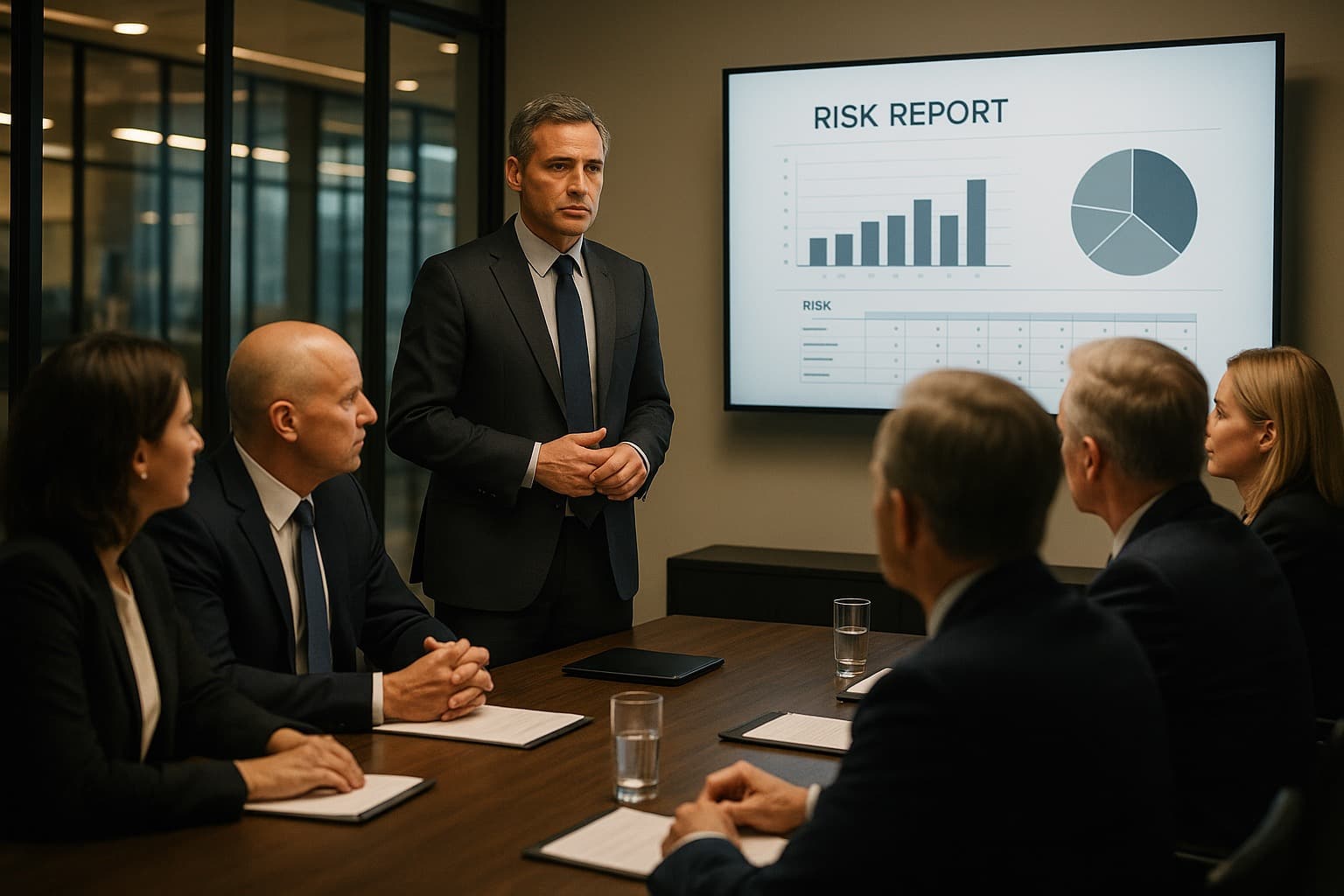
A CFO at a $90M healthcare company sits in a board meeting. The agenda item is technology risk. The CTO presents 14 slides about cloud migration progress, API modernization, and security certificate renewals.
The board nods politely. Nobody asks a question. The topic moves on in six minutes.
After the meeting, the board chair pulls the CFO aside: "I have no idea whether we have a technology problem or not. Can you figure it out?"
This happens at mid-market companies constantly. Not because CTOs are bad communicators. Because nobody taught them that board-level technology reporting is fundamentally different from technology team reporting. The audience does not want to know what the technology team is doing. They want to know three things:
- What could go wrong that would cost us money or customers?
- How likely is it?
- What are we doing about it?
Everything else is noise.
Why Mid-Market Companies Get This Wrong
Enterprise companies have GRC platforms, dedicated risk officers, and board reporting frameworks that have been refined over decades. Mid-market companies, $20M to $200M in revenue, typically have none of that.
What they have instead is a CTO or VP of Engineering who reports technology status in the format that makes sense to them: project updates, uptime metrics, headcount requests, and technology roadmap progress.
The disconnect is not about intelligence. It is about framing. CFOs think in terms of risk exposure, financial impact, and probability. CTOs think in terms of systems, capacity, and technical capability. Without a translation layer, board members cannot make informed decisions about technology investment, and CTOs cannot get the resources they need.
The One-Page Technology Risk Report
After working with dozens of mid-market boards, we have found that one format consistently works. It fits on a single page, takes five minutes to present, and generates the right questions from board members.
Section 1: Risk Summary (Top of Page)
Three to five technology risks, each described in one line with three attributes:
| Risk | Financial Exposure | Status | |------|-------------------|--------| | Single point of failure in billing system | $2.4M revenue at risk if key engineer leaves | 🔴 Unmitigated | | Security compliance gap for SOC 2 renewal | $800K in at-risk contracts requiring certification | 🟡 In progress, Q2 target | | Legacy platform cannot support new pricing model | $3.1M in projected revenue from tiered pricing delayed | 🟡 Architecture review underway | | No disaster recovery test in 18 months | Unknown exposure, last tested environment has since changed | 🔴 Scheduling for Q2 | | Data integration blocking acquisition synergies | $1.8M in expected cost savings from consolidation delayed | 🟡 Vendor evaluation in progress |
This section answers the board's first question: What could go wrong?
Every risk is expressed in dollars or customer impact. Not in technical terms. Not "our monolith needs refactoring." Instead: "Our billing system has one engineer who understands it, and $2.4M in monthly revenue flows through it."
Section 2: Quarter-over-Quarter Trend (Middle of Page)
A simple visual showing whether the overall risk posture is improving, stable, or deteriorating. This can be as simple as:
- Q4 2025: 5 risks identified, 2 red, 3 yellow
- Q1 2026: 5 risks identified, 2 red, 2 yellow, 1 green (resolved)
- Trend: One risk resolved (vendor redundancy). Two remain unmitigated. Net risk exposure decreased by $400K.
Board members care about direction more than absolute position. A company with five risks that is resolving them systematically is in better shape than a company with three risks that has no remediation plan.
Section 3: Investment Request or Decision Needed (Bottom of Page)
Every effective board report ends with a clear ask. Technology risk reports should do the same.
Examples:
- "Requesting $120K to cross-train a second billing system engineer and document the architecture. This mitigates $2.4M in single-point-of-failure risk."
- "Recommending $45K for a disaster recovery test. If we pass, our cyber insurance premium drops by $30K annually."
- "Need a board decision on whether to invest $350K in platform modernization now or accept the risk that tiered pricing launch slips to Q4."
This is where CFOs become allies instead of gatekeepers. When technology investment is framed as risk mitigation with quantified exposure, CFOs can evaluate it the same way they evaluate any other business investment.
Building the Report: A Step-by-Step Process
Step 1: Identify Risks in Business Terms
Start with your technology team's list of concerns. Then translate each one:
Technical framing: "We need to migrate off our legacy authentication system." Board framing: "Our customer login system uses a framework that the vendor stopped supporting in 2024. If a security vulnerability is discovered, we cannot patch it. This exposes us to a data breach affecting 40,000 customer records and potential regulatory penalties."
Technical framing: "We have too much technical debt in the payment module." Board framing: "Our payment processing code has not been maintained in three years. Adding new payment methods, which two enterprise prospects have requested, requires a rebuild that will take 4-6 months. We risk losing $600K in potential ARR if we cannot support these integrations by Q3."
The translation follows a pattern: What is the business asset at risk, what is the scenario, and what is the financial exposure?
Step 2: Quantify Exposure
Every risk needs a dollar figure or customer impact number. This does not need to be precise. A range is acceptable. What matters is that board members can compare the cost of the risk against the cost of mitigation.
Methods for quantification:
- Revenue at risk: If this system fails, how much revenue is affected and for how long?
- Customer at risk: How many customers are exposed, and what is their combined contract value?
- Regulatory exposure: What are the potential fines or audit costs?
- Opportunity cost: What revenue or efficiency gains are blocked by this risk?
- Remediation cost if deferred: How much more expensive does the fix become if we wait 12 months?
Step 3: Assess and Assign Status
Use a simple three-color system:
- 🔴 Red: Risk is unmitigated. No plan in place or plan has stalled.
- 🟡 Yellow: Risk is acknowledged and remediation is in progress with a target date.
- 🟢 Green: Risk has been mitigated or reduced to acceptable levels.
Resist the temptation to make everything yellow. If two things are red, say so. Boards respect honesty about risk far more than they respect the appearance of control. A report with five yellows and no reds signals that either the company has no real risks (unlikely) or the reporter is not being candid (more likely).
Step 4: Track Quarter over Quarter
Create a simple spreadsheet or document that records each quarter's risk register. Over time, this builds a narrative:
- Risks that were identified and resolved demonstrate execution capability
- Risks that persist quarter after quarter signal resource gaps or leadership alignment issues
- New risks that emerge are expected, a static risk register suggests nobody is looking
Step 5: Present with a Decision Framework
End every presentation with one of three framing statements:
- "We need investment." Here is the specific amount, here is what it mitigates, here is the timeline.
- "We need a decision." Here are two options with different cost and risk profiles. The board should choose.
- "Awareness only." Here is a risk we are monitoring. No action needed now, but it may escalate.
This prevents the most common board meeting failure: a presentation that informs but does not lead to a decision.
Common Mistakes in Technology Risk Reporting
Reporting Activity Instead of Risk
"We completed 47 security patches this quarter" is not a risk report. It is an activity report. The risk report version: "We reduced our unpatched vulnerability exposure from 12 critical systems to 3. The remaining 3 are scheduled for Q2, with $1.2M in contract value at risk until resolved."
Using Technical Severity Instead of Business Severity
A "critical" security vulnerability in a system that processes $50K in annual revenue is less important to the board than a "medium" vulnerability in a system that processes $5M. Report in business severity, not technical severity.
Omitting the Cost of Doing Nothing
Every risk has a "do nothing" option. Make the cost of that option explicit. "If we do not invest in disaster recovery testing ($45K), we are accepting the risk that a system failure during peak season could take 72 hours to recover instead of 4 hours. The revenue impact of a 72-hour outage during our peak month is approximately $890K."
Reporting Too Many Risks
If you have 15 items on your risk report, you have a prioritization problem, not a reporting problem. Board members can meaningfully engage with three to five risks per meeting. Prioritize by financial exposure and present the top five. Keep the full register available for questions.
The CFO's Role in Technology Risk
CFOs at mid-market companies increasingly own the technology risk conversation, whether they want to or not. Boards expect the CFO to understand technology risk in the same way they understand financial risk, market risk, and operational risk.
This does not mean the CFO needs to become technical. It means the CFO needs to:
- Ensure technology risks are quantified in financial terms. If the CTO cannot do this, bring in an outside advisor who can.
- Integrate technology risk into the overall enterprise risk framework. Technology risk should appear alongside market risk, regulatory risk, and operational risk, not in a separate silo.
- Challenge optimistic timelines. If the CTO says a critical remediation will take three months, the CFO should ask what happens if it takes six.
- Connect technology investment to business outcomes. Every dollar spent on technology should map to revenue protection, cost reduction, or capability enablement.
Getting Started
If your company does not have a technology risk reporting framework, start with the one-page format described above. It takes one afternoon to build the first version and 30 minutes per quarter to update.
If your CTO struggles to translate technical risks into business terms, that is a common and solvable problem. An outside technology advisor can facilitate the first one or two reports and establish the framework for ongoing reporting.
At Pineapples, we help mid-market companies build technology risk reporting frameworks that boards actually use. We translate technical complexity into business language, quantify exposure, and establish the quarterly reporting cadence that keeps technology risk visible and manageable.
Frequently asked questions
What should a technology risk report for a board include?
An effective board-level technology risk report fits on one page and covers three things: a summary of three to five risks expressed in dollars or customer impact, a quarter-over-quarter trend showing whether risk posture is improving or deteriorating, and a clear investment request or decision item at the bottom. Boards want to know what could go wrong, how likely it is, and what is being done about it. Everything else is noise.
How do you translate technical risks into business language for a CFO or board?
Each technical concern should be reframed around a business asset, a failure scenario, and a financial exposure. For example, instead of 'our payment module has technical debt,' the board framing is 'our payment code has not been maintained in three years, and two enterprise prospects need integrations it cannot support, putting $600K in potential ARR at risk if we miss a Q3 deadline.' The pattern is: what is at risk, what is the scenario, and what does it cost.
How many technology risks should appear on a board report?
Three to five risks per meeting is the recommended limit. If a risk register has 15 items, that signals a prioritization problem rather than a reporting problem. Prioritize by financial exposure and present only the top five, keeping the full register available if board members ask for more detail.
What is the CFO's role in technology risk reporting at a mid-market company?
CFOs at mid-market companies increasingly own the technology risk conversation alongside the CTO. The CFO's job is to ensure every risk is quantified in financial terms, integrate technology risk into the broader enterprise risk framework alongside market and operational risk, challenge optimistic remediation timelines, and connect every technology investment to a clear business outcome such as revenue protection or cost reduction. If the CTO cannot translate risks into business terms, the CFO should bring in an outside advisor to facilitate the process.
Written by Anthony Wentzel