
Product Strategy
MVP Development Services: One Workflow, Then Stop
Published Mar 1, 2026. Updated Oct 14, 2026
MVP development services build one workflow a named user can finish, and leave every other feature out of the first release.
MVP Development Services: One Workflow, Then Stop
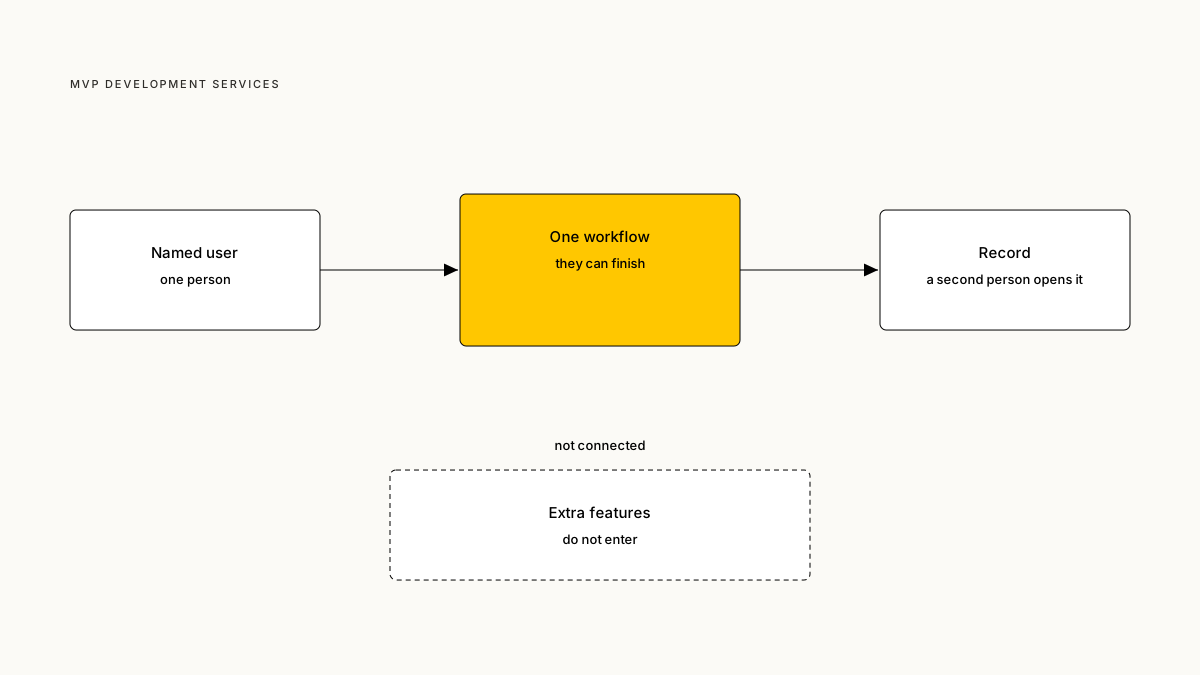
MVP development services build one workflow a named user can finish, with a record a second person can open. I start with that user and that workflow. I do not start with a feature list. If I cannot name the user, I do not have a first release.
The real problem
The first meeting is a backlog. Every department has a feature that feels small. The launch date is a wish. Nobody can say which person finishes which path, or where the record of that finish lives.
I will not relabel a finished file as an MVP to make this page sound busier. HIPnation is a membership-medicine group. Inbound patients were getting lost between the phone, the inbox and the EHR. We rebuilt the funnel as the product. Elation and Hint stayed on the EHR side. A Dialpad comms hub sat on the conversation side. Every inbound is acknowledged in under a minute and booked inside the conversation. The result is +28% patient leads, Feb to Jul 2026. That was a production funnel for a company that already had patients. It was not a first release. The discipline is the part I will reuse. One workflow. A record a second person can open.
The other file is also not an MVP, and I will not blend the two. A $3.4M React Native engagement. Expo plus Expo Router on the web. at.tv and DirecTV shipped from one codebase. The second brand is a theme. The screens stay shared. The easy next spend was a second website. The work was to refuse that fork. A proof got the room to nod. Enterprises stay slow to align. I will not invent a week count to hide that gap.
I do not add a headcount, a timeline, a quote, or a savings figure on top of either file.
I am writing to the operator who needs one workflow in the hands of one user, and who already has the rest of the company running. On this site, that buyer is named on AI-native SaaS for PE and mid-market.
Principles
Name the user before you name the feature list. MVP development services go wrong when the first artifact is a ranked backlog. The first artifact is a person, in one sentence, and the workflow that person must finish. If I cannot say who finishes it, I do not have a release. I have a tour.
Viable means a second person can open the record. A clickable path that dies in the presenter's laptop is not a product. The finish has to land somewhere a second person can audit. On the HIPnation funnel the patient and the conversation are the same chain. That is why the lead number is a number. A demo with no record is a story.
Extra features do not enter. Sales, the board, and a customer can all be right and still not be this user. The service is the refusal as much as the build. I will not score that refusal with a framework I cannot tie to the user.
A proof gets a nod. It does not finish the alignment. PoCs win buy-in. Enterprises stay slow to align. I will not invent a calendar, a week count, or a phase chart to hide that gap. The $3.4M React Native engagement is the file that taught me the limit. I will not call that file an MVP.
When the website is the product, do not force it through a phone primitive set. A document site, or a portal with no mobile twin, belongs in a web framework. That work is React and Next.js.
How we actually build it
I name the user. I name the one workflow. I name the record. Then I stop adding objects.
The build is that path, finished, with the record a second person can open. I do not start by replacing the systems the company already trusts. If a product the company can already buy runs that workflow, including the record and the owner, I do not build.
On a first release the temptation is a second workflow that "will be cheap now." It is not cheap. It is a second product hiding in the same sprint. I leave it out. The figure on this page is that refusal. Extra features sit on a dashed box. They do not get an arrow.
I will not publish a week-by-week plan. I do not have a file that supports a universal duration, and a borrowed calendar would be a metric I made up.
What we learned
The two files taught me to keep the claim as small as the file.
HIPnation's +28% patient leads, Feb to Jul 2026, came from a production funnel, not from a first launch. Phone, inbox, EHR. Acknowledgment in under a minute. Booking inside the conversation. I can reuse the shape. I cannot reuse the label. Calling that funnel an MVP would be a lie about a company that already had patients.
The $3.4M React Native engagement taught me that the second brand is a theme, and that a proof does not finish the alignment. PoCs win buy-in. Enterprises stay slow to align. I will not add a headcount, a timeline, or a savings figure to make the gap look smaller. I will also not sell that engagement as MVP development services. The screens already existed.
I will not average the two files into one outcome. A membership-medicine funnel and a two-brand codebase are different objects. A blended price would be a number I made up.
When this isn't the right fit
It is the wrong work when a product you can already buy runs the workflow, including the record and the owner.
It is the wrong work when the company already runs this workflow in production and the failure is the edge, not the absence of a first release. That is modernization. It is not an MVP.
It is the wrong work when the ask is every department's feature in one pass. I have no file that supports that.
It is the wrong work when the company is small and the object is one workflow a person already does by hand. That fit is AI automation services for small business. The unit there is a workflow, not a new product launch.
It is the wrong work when the thing you want from this page is a price. I do not publish one.
Frequently asked questions
What is MVP development Services?
MVP development services build one workflow a named user can finish, with a record a second person can open. The rest of the feature list stays out. It is not a clickable tour, and it is not a rewrite of every system the company owns.
What does the company MVP do?
I am not describing a vendor whose legal name is MVP. On this page the letters mean minimum viable product. The service is one workflow for one named user. If a seller cannot name that user, they are selling a feature list.
How much does it cost to develop an MVP?
I will not give a cost. An average would pretend two different objects are one purchase. A $3.4M React Native engagement, the one that shipped at.tv and DirecTV from one codebase, is the size of that file. It is not the price of an MVP. I do not publish a rate card on this page.
What does MVP stand for in development?
Minimum viable product. Viable means a named user can finish the workflow, and a second person can open the record of that finish. A prototype nobody can audit is not viable. I will not stretch the letters into a timeline I do not have.
Written by Anthony Wentzel