
Enterprise AI Strategy for Mid-Market: A 4-Step Order

Anthony Wentzel
Founder, Pineapples
Enterprise AI Strategy for Mid-Market: A 4-Step Order
An enterprise AI strategy decides which business problems AI should solve first, what data and controls must exist before it runs, and who owns the results. For mid-market companies, the order matters more than the tools. Fix data access and governance, pilot one measurable workflow, then scale what proves out.
I write this for the operator who was handed a deck written for a center of excellence and a year of runway. You have a business that already runs, a stack you already pay for, and a board that will ask what moved.
Two files sit under this page. An anonymous advisor stack that had to be vaulted before anyone chased agentic depth. HIPnation, a membership-medicine funnel, where patient leads moved because the handoff was the product. I will not add a tool list, a seat count, or a savings figure I do not have.
What is an enterprise AI strategy?
An enterprise AI strategy is the decision record for AI inside the company. It names the first business problem, the data and controls that must exist before a model touches that problem, and the person who owns the result when the output is wrong on a Tuesday.
A shopping list of models is a catalog. A chatbot pilot with no baseline is a pilot. The strategy is specific enough to refuse work: whether the customer file is one system of record, who approves what leaves the perimeter, and which number has to move before a second workflow is funded.
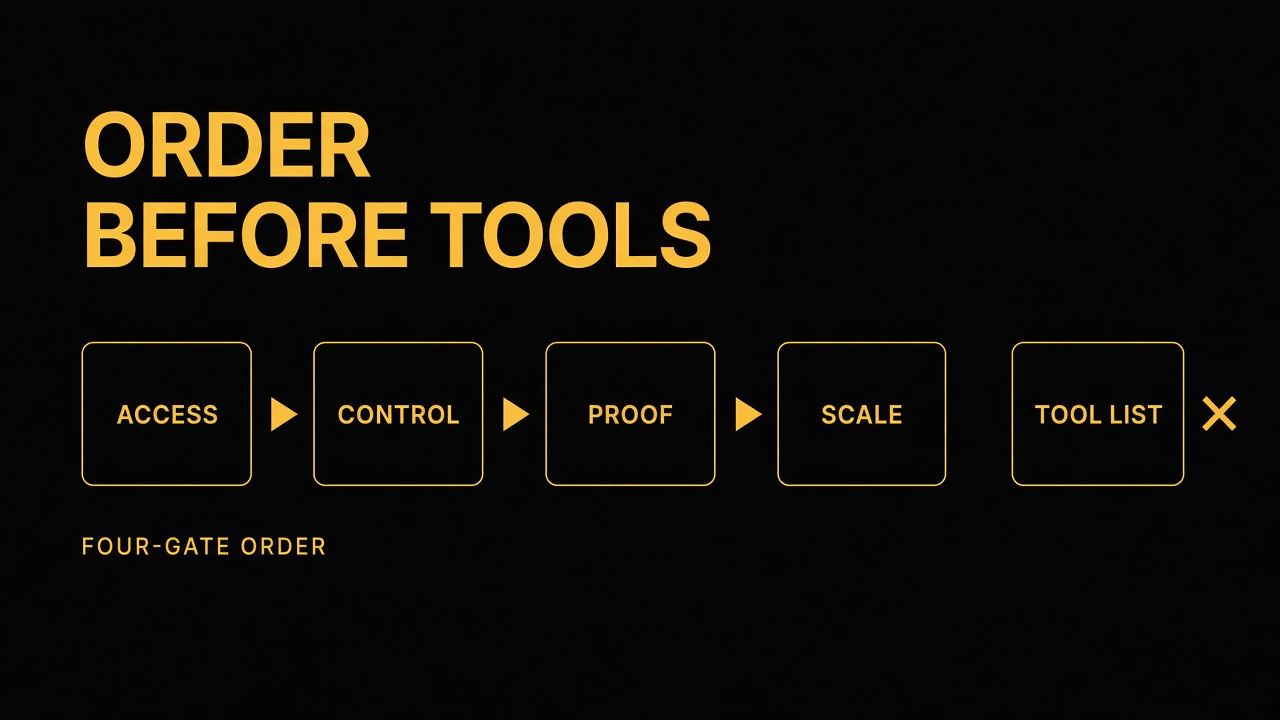
I use one name for the sequence: the Four-Gate Order. Access, then control, then proof, then scale. The gates are the strategy. The tools are what you pick after a gate is open.
AI readiness assessment is the read I run before Gate 1. It scores data, systems, ownership, change capacity, and security, then names who would run the first workflow. How to choose AI consulting services is the buyer page for the seat that carries the order.
How do you build an enterprise AI strategy?
You build it by walking the Four-Gate Order in sequence and writing down what failed. You do not build it by collecting use cases from every department and scoring them in a workshop that nobody has to live with.
Gate 1, Access. Name the system of record the workflow will read. If two people can produce two official numbers for the same week, you do not have access. You have files. Fix the split before you point a model at it.
On an anonymous advisor file, behavior, financials, annuities, and Roth sat in four data planes. Each plane could look complete and still disagree with the others. We put them on one AI-native MCP, an AWS vault, and a unified portal. Advisors got one login. Agents got one truth. I do not name the client. Vault the data before you chase agentic depth is that file. Depth on the split would have made the mess faster.
Gate 2, Control. Name what an agent may touch, who approves it, and which exception stays human. You need one sentence a manager can repeat: this data can be read, this data cannot leave, this case stops for a person. Agentic workflows are that sentence in production: a named owner, a system of record the loop can read and write, and a human gate on the exception. If any of the three is missing, you are still on Gate 2.
Gate 3, Proof. Pick one workflow that already has a baseline. Give it one owner. Run it until the number you already track moves, or until you can say it did not. A launch is not proof. A demo on sample data is not proof.
HIPnation is a membership-medicine group. Inbound patients were getting lost between the phone, the inbox, and the EHR. We rebuilt the funnel as a product, with Elation and Hint, a Dialpad comms hub, and deterministic patient-to-conversation linkage. Every inbound is acknowledged in under a minute and booked inside the conversation. Patient leads moved +28% from Feb to Jul 2026. That number is funnel work. It is not an SEO result, a local ranking, or a map listing. The lesson for this page is the shape: one handoff, one owner, one number. The strategy did not start as a platform.
Gate 4, Scale. Repeat only what Gate 3 already showed. The second workflow uses the same access test, the same control sentence, and the same kind of baseline. A backlog is not scale. A second vendor because the first one launched is not scale. When a gate fails, you stop. Parallel pilots are how a thin bench ends the quarter with four demos and no number.
What are the components of an enterprise AI strategy?
The components are the four gates, written so someone who was not in the room can score them. I keep a short scorecard. It is a list, and it is meant to be filled in with names, not with colors.
- Access: One system of record the workflow can read. Pass if last week's number can be reconstructed without the person who keeps the spreadsheet. Fail if the official figure still lives in a mailbox.
- Control: A named approver for what an agent may touch, and a human gate on the exception. Pass if that person can pause the loop on a Tuesday. Fail if the policy is a document nobody has used.
- Proof: One workflow, one baseline, one owner. Pass if the number you already track moved, and you can say what changed in the work. Fail if the update is "we launched."
- Scale: The next workflow is a copy of a proof, with the same three names filled in. Pass if you can point at the first result. Fail if the plan is a portfolio that has not shipped once.
Rank candidates by whether Access and Control already pass, then by whether you can name the baseline. The first use case is the one you can already measure. The rest wait. Enterprise writeups often add a platform, an operating model, and a review cadence on top of those four lines. Staff those rooms when you have them. Until then the scorecard is the component list.
How is an enterprise AI strategy different for mid-market companies?
A large enterprise can fund a portfolio, a platform team, and a year of foundations before a business owner sees a number. A mid-market company funds one proof. The strategy is the refusal to pretend you have the first bench.
You still decide the problem, the data, the controls, and the owner. You do it for one workflow, on the systems you already run, with the person who will still be there after the readout. Scale means the next workflow that same owner can run without dropping the first. If the bench cannot hold two, finish Gate 3.
Data readiness is stricter here because a bad source has nowhere to hide. If the CRM, the inbox, and the finance export disagree, an agent will pick one and sound sure. That is the advisor file again: four planes, no single truth until the vault existed. Put the human gate in the first workflow, the same test agentic workflows use.
Hire AI consulting services for mid-market companies to walk the Four-Gate Order on that one workflow. A proposal that opens with a platform and a maturity model was written for a larger bench.
What are common mistakes in an enterprise AI strategy?
I see the same five, in this order.
- Tools before the problem. A seat purchase, a model shortlist, or a vendor demo becomes the strategy. The business problem shows up later, as a justification. Reverse it. Name the problem and the number first.
- Agents before the vault. The model is pointed at a split stack. It answers quickly from whichever plane it reached. The advisor file is the correction: one login and one truth before depth. Vault the data first.
- Governance after the incident. Legal, security, and the human gate arrive when something has already gone out. Control is Gate 2 because it is cheaper there. A policy written in week twelve does not rewind week four.
- A portfolio before one proof. Twenty use cases feel like ambition. They are a way to avoid picking. One workflow with a baseline will teach you more than a scored backlog nobody runs.
- A launch treated as a result. "We went live" is activity. HIPnation's +28% patient leads from Feb to Jul 2026 is a result because the funnel changed and the number moved. It is funnel work, not a ranking lift. Do not borrow a result you did not measure.
A committee that "owns AI" is the sixth miss. Committees do not pause a workflow on a Tuesday. A person does.
Who should own an enterprise AI strategy?
The owner is the person who can stop the work. Title is optional. The job is to pause a miss, explain it, and keep the exception human.
The business owner owns the number you already report. The operator owns which system is read, what may leave, and where the human gate sits. On a mid-market team those two roles are often the same person. One named person beats a chief AI officer, a data office, and a risk committee you do not have. When that judgment is part time, the seat is a fractional chief AI officer.
A vendor can build the workflow. If the only person who can explain the output leaves when the pilot launches, Gate 3 is still open.
AI consulting services rent the operator seat while you name the internal owner. The engagement should leave a name on the scorecard. If you need the read before you hire anyone, start with the AI readiness assessment so you do not fund Gate 3 while Gate 1 is still a mailbox.
If you already know the workflow and the system it has to touch, start in chat. Bring the owner and the number you want to move. I will walk the four gates with you and tell you which one is actually closed. On our own site, the tools an agent can call are registered in the browser. That writeup is WebMCP: How We Made pineapples.dev Usable by AI Agents.
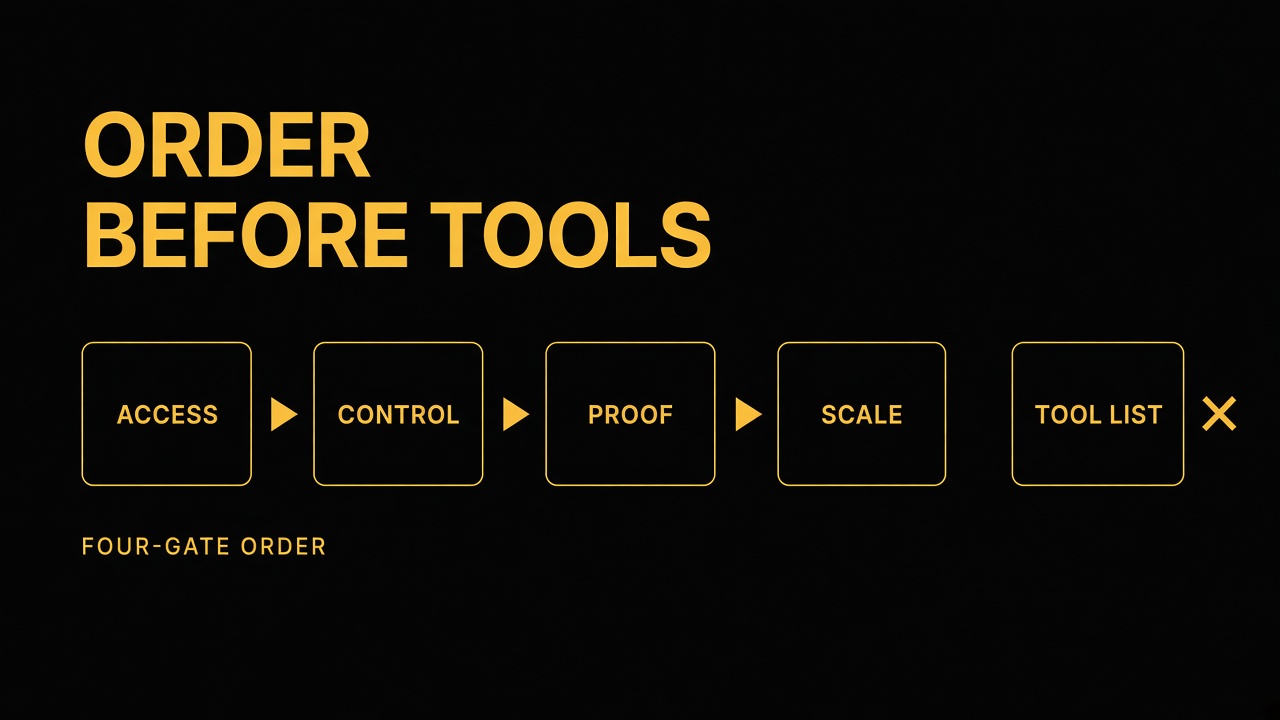
The diagram is the order. Access, control, proof, scale. The tool list sits off the chain.
What should I read next?
Frequently asked questions
What is an enterprise AI strategy?
An enterprise AI strategy decides which business problems AI should solve first, what data and controls must exist before it runs, and who owns the results. It is a sequence, not a tool list or a seat count. For a mid-market company, that sequence is the strategy.
How do you build an enterprise AI strategy?
Build it as the Four-Gate Order. Access means one system of record the workflow can read. Control means a named approver and a human gate on the exception. Proof means one measurable workflow with an owner. Scale means repeating only the workflow that already moved a number.
What are the components of an enterprise AI strategy?
The components are the four gates. Access is data readiness. Control is governance. Proof is one use case with a baseline and an owner. Scale is permission to repeat what already moved a number. A component with no name on it is a slide.
Who should own an enterprise AI strategy?
A named operator owns the result. The business owner owns the number the workflow is supposed to move. The same person, or a named partner, owns the gate that pauses a miss. On a mid-market bench that is one seat, not a center of excellence and not a vendor login.
What are common enterprise AI strategy mistakes?
The mistakes I keep seeing are buying tools before naming the problem, pointing agents at split data, writing governance after an incident, funding a portfolio before one proof, and treating a launch as a result. A thin bench feels each of those in the same quarter.
Working a live deal?
Book a 30-minute working session.
Same operator who runs the diligence engagements. No SDRs, no sales team. Bring the target, I'll bring the checklist.
Share this article
Anthony Wentzel
Founder, Pineapples
Anthony Wentzel has spent 26 years helping mid-market, PE, and family-office operators turn technology risk into decisions they can own. He is the founder of Pineapples.