
AI Strategy
What Data Governance Consulting Delivers in a First Engagement
Published Oct 29, 2026
Data governance consulting names the owner, definition, access rule, and quality check a mid-market or PE company needs before an agent reads the row.
What Data Governance Consulting Delivers in a First Engagement
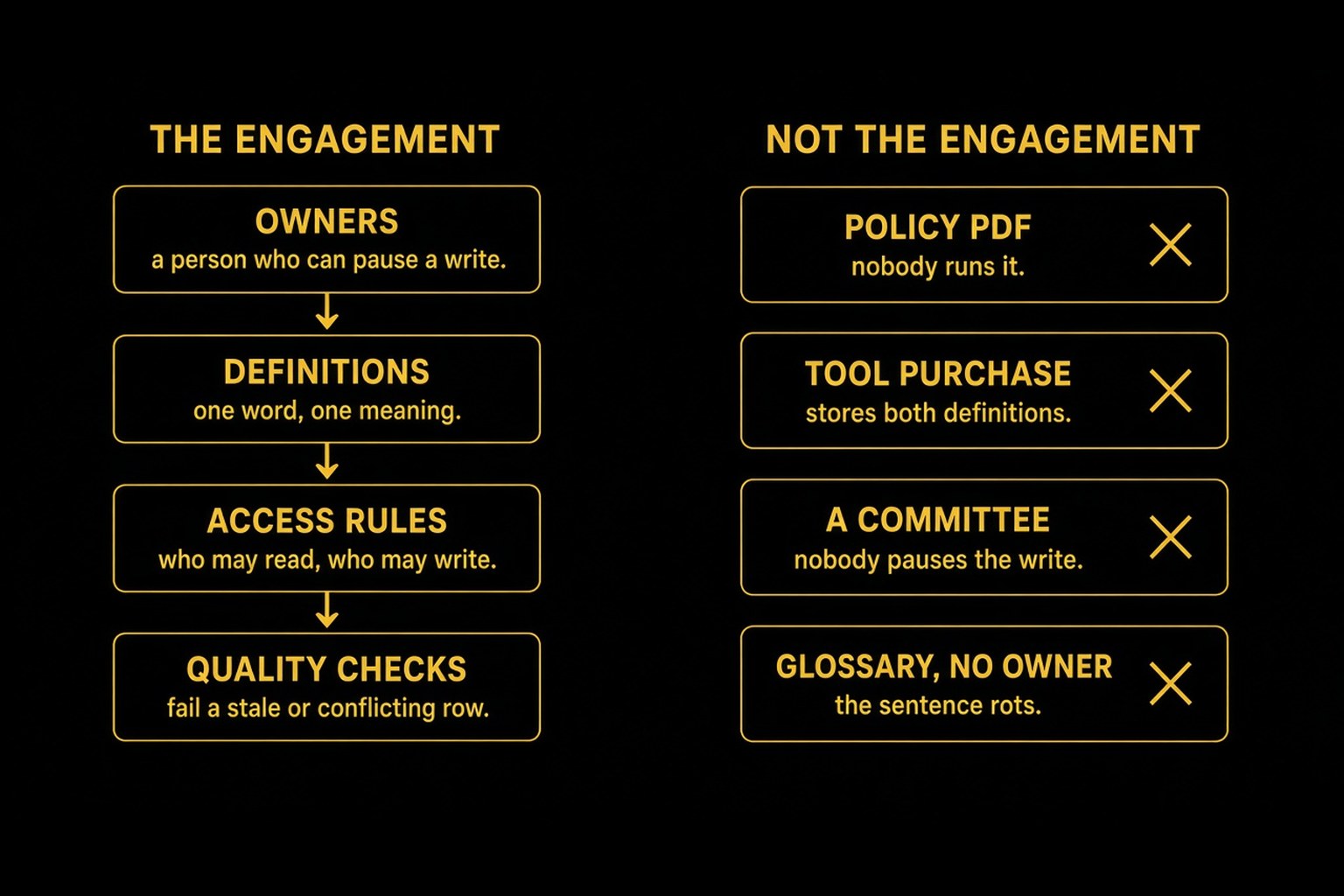
Data governance consulting delivers the operating rules a mid-market or PE-backed company can run: a named owner for each important record, a definition that one word means one thing, an access rule for who may read or write, and a quality check that fails a stale or conflicting row before an agent treats it as true.
I write this for the operator who already heard "we need governance" and was handed a framework template. I build agentic systems and the data platforms under them. I sit with PE and mid-market teams when the first agent is about to write back into a system the company already reports from. The gap I keep finding is not a missing policy. The gap is four blank lines on the record the agent will touch.
What data strategy consulting delivers before AI is the hub above this page. That page decides which source is allowed to win. This page is the spoke under it. It is how you keep that decision true after the workshop ends. If the source is still a fight, stop here and go write the source down. Governance on two official sources is a faster way to store the fight.
What does data governance consulting actually deliver?
It delivers a short operating record a person who was not in the room can score on a Tuesday. I keep it to four lines, and I keep them on one record type at a time. A company-wide program is how this work dies.
Owner. The person who can pause a wrong write. Not a committee. Not a vendor login. Not the analyst who built the spreadsheet and is leaving in June. If you cannot name that person, the line is blank.
Definition. One word, one meaning, written so two teams cannot both be right. "Active customer" is the usual fight. Sales means a meeting happened. Finance means an invoice was paid. The agent will pick one and sound sure. The definition says which one is allowed to win, and what the loser is called so it does not sneak back in under a synonym.
Access rule. Who may read the record, who may write it, and which system is allowed to do the write. A shared inbox password is not a rule. A role named "admin" that half the company holds is not a rule. The rule fits in a sentence. This role may read. This role may write. The agent may do one of those, or neither.
Quality check. The test that fails the row before the agent uses it. Stale. Conflicting. Missing the sign-off. Missing the owner. A check that only logs a warning is a diary. The check I will stand behind fails closed. The row does not enter the answer.
If any line is blank, the consulting is not done. A maturity poster with colors does not tell the agent which row to trust. I have watched teams frame the poster and then point a model at the export anyway.
What does a first engagement produce?
A first engagement produces those four lines for the records the next workflow will actually touch. It does not produce a catalog of every field in the company. I have started that catalog. It becomes a project about the catalog.
The packet is a record list, a conflict list, and the four lines on each winner. Questions with two answers go on the conflict list. "We will reconcile later" is not an answer. Later is how an agent industrializes the split. Clean the records before AI agents touch operations is the repair when the conflict is dirty rows, not a missing decision. Do the decision first. Cleaning a row you have not defined gives you a cleaner ambiguity.
The definition has to be a sentence two teams can both repeat. If they cannot, you have two slides. The access rule includes the agent. The agent is a principal, not a neutral pipe. A write that lands in a side spreadsheet is a new source of record, and you just undid the strategy. The quality check names the condition and what the workflow does when it trips. Stopping the answer, and showing which check failed, is a behavior. "Someone reviews the dashboard" is not.
The last page of the packet is a refusal list. The AI work that waits. A governance engagement that approves every proposed agent is a backlog with a new cover. I hand the packet to the person who will still be employed when the first wrong write happens. If it only lives in my notes, the engagement failed.
How do you tell that you need it before AI work?
You need data governance consulting when the company is about to let an agent read or write, and the four lines are still slogans.
Two teams use one word for two rows. I ask each team to pull "active customers" for last month without talking to each other. If the files differ, you do not have a definition. You have a meeting you have been postponing. An agent will not postpone it. It will pick the file that came back first.
Access is a shared login, or a vendor admin account nobody on your leadership team can recover. The agent inherits that access, because that is what the integration was given.
The quality check is social. "Someone will notice." People notice the first bad demo. They stop noticing once the bad row has been copied into the system the board reads. Vault the data before you chase agentic depth is the store I put under this when the planes themselves disagree. A vault without the four lines is a larger pile. Put the rules on the records, then put the records in one place you own.
On a live deal, the same test is a price question. Technical due diligence asks whether the data model can hold the plan the buyer intends to run. A stack diagram can be true and still leave you owning three definitions of revenue. If the operating plan uses a word the target uses three ways, do this read before you fund an agent on the target. I will not invent a discount to attach to that finding. The finding is the point. You cannot automate a word you have not defined.
You do not need this engagement when the four lines already have names. One owner. One definition two teams can repeat. One access sentence. One check that fails closed. In that case the next page is the build, not another workshop. Funding governance theater on top of rules you already run is how a thin bench loses a quarter.
What do the four lines look like on a live file?
This is an anonymous wealth advisory platform we build. I do not name the client. The shape is already on the strategy page and the vault page. I am using it here for the governance lines.
The planes were behavior, financials, annuities, and Roth. Each plane could look complete and still disagree with the others. Pointing an agent at that split does not create a definition. The agent picks a plane. The governance work, the part this page is about, was the rules we wrote so a later agent could not treat a convenient plane as the truth.
Definition, by boundary. Ingestion and record matching stay inside one organization. A record from one firm does not resolve against another firm's book. That is a definition of identity. "Customer" does not mean every similar name the model can see. It means a person inside this book.
Quality, on the row itself. A product consideration carries a version, a validation flag, a staleness mark, and a sign-off. An old consideration is not a current one because the row is still in the database. The check fails the stale row. A typed yes in a chat does not count as the sign-off. The sign-off is a field a person set, with a time, that the next run can read.
Access, by workspace and by role. Work sits in named workspaces, so a second team does not inherit the first team's files. A new investment agent is gated to admins. A demo that worked is not permission for every login. The access rule is that sentence, not a hope that the prompt will be careful.
Owner, on the miss. Someone can pause the write. On this file that person is not a committee and not the model vendor. If you cannot point at them on a Tuesday, the quality check is a log nobody reads.
I am not attaching a savings figure to those lines. Define the row. Fail the bad one. Then let an agent read what passed. The cleansing page is where a SKU had to mean one thing before an agent was allowed to invoice it. I will not retell that file here.
What do data governance consulting services include, and what do they refuse?
Data governance consulting services are that packet, in order. One workflow, not a department. The records that workflow needs, cut until a person can hold the list. A conflict list with a winner. A name that can stop a write this week. An access sentence that includes the agent. A quality check that fails closed in the path the agent will use, not in a slide. A refusal list of agents that wait.
I refuse five substitutes that show up in the proposals I read.
A policy PDF that restates a framework and names nobody. It will not be open on the day the agent writes the wrong status.
A tool purchase. A catalog, a catalog of catalogs, a warehouse. The tool will store both definitions and let you query either one with confidence.
A committee as the owner. Committees do not pause a job at 4 p.m. A person does.
A glossary nobody is paid to keep true. Definitions rot the week a contract changes. If the owner does not update the sentence, the sentence is already false.
A pilot that will "figure out governance as it goes." The pilot writes. The next run treats that write as evidence. You did not discover the definition. You published one by accident. Ask who is in the room when the first check fails. If the answer is nobody on your side, you bought a document.
How is this different from AI governance consulting?
AI governance consulting is the other job. It decides which model and agent actions may send, pay, post, or delete, and what the audit trail has to show. This page decides whether the row those actions read is owned, defined, and current.
A clean definition does not stop an agent from emailing a customer. An approval gate on send does not tell you what "active" means. If the row is the fight, stay on this page. If send is already wired, do the other page first, then come back before you trust the mail.
What if the owner line is the empty seat?
Sometimes the four lines are writable and the name is not. Nobody currently employed can pause the write and still be there next month. That is a seat question, not a glossary question. The business case for a fractional CTO is the seat when the blank is product and engineering judgment. A fractional CIO shape owns the operating systems and the reported number. Do not add a title to decorate the policy. Hire the person who will keep the four lines true after I leave the room.
What to do this week
Pick one record the next agent will touch. Write the four lines. Owner, definition, access rule, quality check. Read them out loud to the two people who disagreed last month. If they both repeat the definition, and the check fails a stale row in the real system, you are done with this page.
If they cannot, do not fund the agent, and do not buy a platform to hide the gap. Bring the two files that disagree. If the file is a deal, put the definitions in the diligence read before you put an agent on the target.
If you already know which record is fighting you, start in chat. I will tell you which of the four lines is actually blank.
Related reading
Frequently asked questions
What is data governance consulting?
Data governance consulting is the work of writing the operating rules for the records a company will trust. A first engagement names an owner, a definition, an access rule, and a quality check for the data an AI agent is about to read or write. A policy PDF, a tool purchase, and a glossary with no owner are not that work.
What do data governance consulting services include?
The services are a record list, a named owner for each record, a definition that one word means one thing, an access rule for read and write, and a quality check that fails a stale, conflicting, or unsigned row before an agent treats it as true. The last item is a refusal list. Work that has no owner waits.
How is data governance consulting different from data strategy consulting?
Data strategy consulting decides which source is allowed to win. Data governance consulting keeps that decision true on a Tuesday. Strategy names the source, the owner, and the control sentence. Governance writes the definition, the access rule, and the quality check that an agent will actually hit.
How do you know you need data governance before AI work?
You need it when two teams use the same word for two different rows, when access is a shared login, or when the quality check is that someone will notice. If one owner, one definition, one access rule, and one failing check already exist for the workflow, skip the engagement and build the agent.
How is data governance different from AI governance?
Data governance decides whether the row is owned, defined, and current. AI governance decides what an agent may do with that row, including any action that sends, pays, posts, or deletes. One page does not cover both jobs. A clean row can still leave the building if the action has no gate.
Written by Anthony Wentzel