
AI Strategy
Data governance best practices: green pipeline, empty metric
Published Nov 5, 2026
The pipeline was green and every title showed 0% sentiment. Data governance best practices count the rows, list skipped stages, and fail parity on empty.

Data governance best practices: green pipeline, empty metric
Our dashboard said 0% sentiment. The pipeline was not broken. It was doing exactly what we told it to.
What data governance best practices catch a silent pipeline gap? Basically 3 things. Count the rows behind every published metric before you trust a green check. List every skipped stage and alert on it, so a stage turned off to keep a parity check quiet cannot stay quiet. Fail the parity check when the table it is protecting is empty.
A silent gap is a pipeline stage that is skipped or empty while every check still passes.
The hub for this work is data governance consulting. That page names the owner, the definition, the access rule, and the quality check. This page is the check that still passes when the metric is empty. Which source is allowed to win sits on data strategy consulting. The table a team fills for the owner and the rule is the data governance framework template.
What did the audience-research tab show?
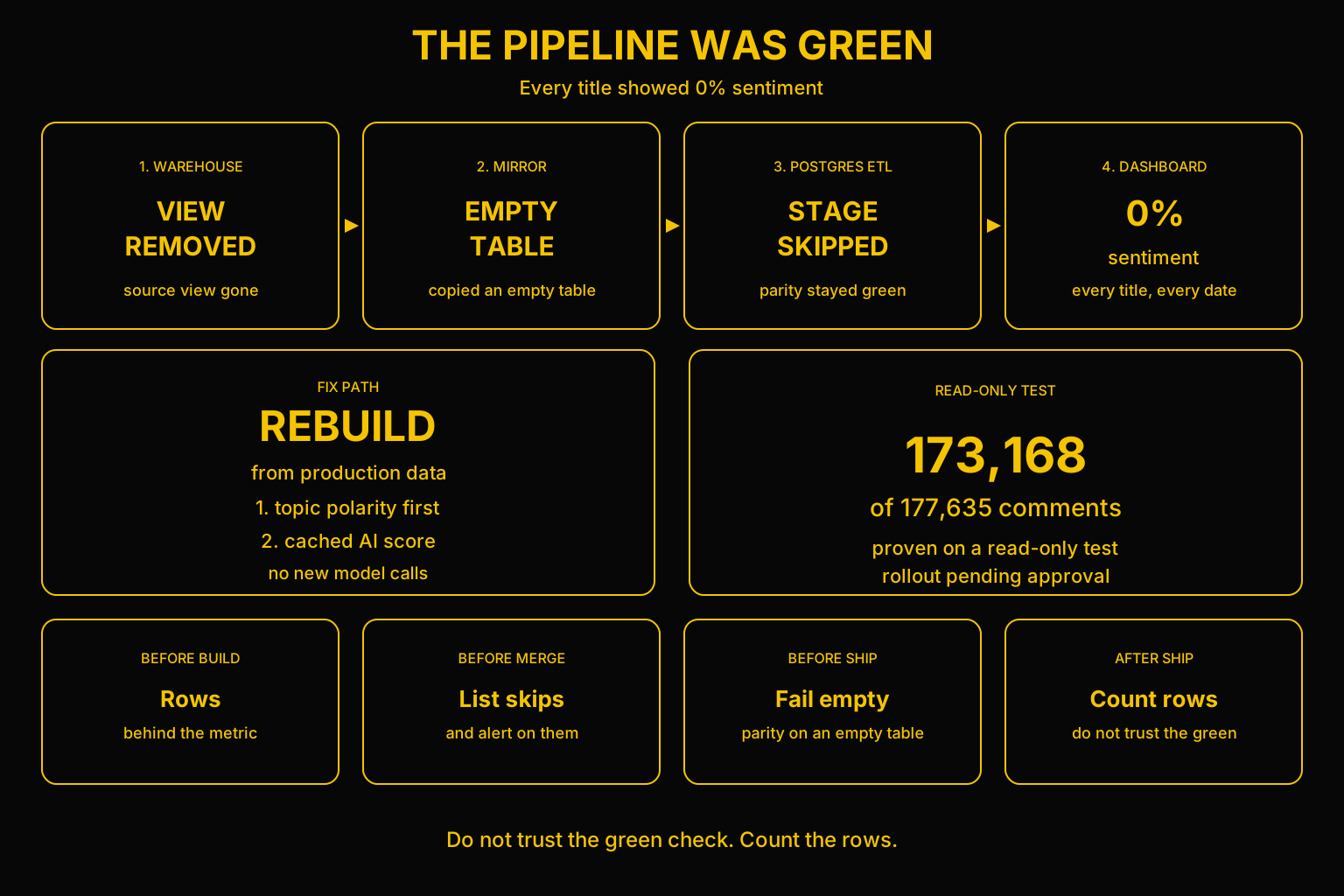
For a media AI platform client, the audience-research tab showed no sentiment for any open-ended answer. Every title showed 0% sentiment. It was not one report. It was every title and every date.
Why did the pipeline stay green?
A source view was removed in the upstream data warehouse. The mirror copied an empty table. The Postgres ETL had been set to skip that stage so the empty mirror would not fail a parity check. So the pipeline stayed green while the metric went empty.
What did we decide?
We decided to rebuild the table from data already in production. Topic polarity first, then a cached AI score. No new model calls.
How does the rebuild work?
Topic polarity comes first, from rows already in production. A cached AI score comes next. No new model calls.
What did the read-only test show?
A read-only test on production scored 173,168 of 177,635 comments. The test did not change production.
What is not rolled out?
Production rollout waits on a deploy approval. This is proven on a read-only test. Rollout is pending approval. We are not calling the dashboard fixed.
What data governance best practices catch a silent gap?
- Before build. Every published metric has rows behind it. If a chart can show a number, someone can count the rows that produced it.
- Before merge. Skipped stages are listed and alerted on. A stage turned off so a check stays quiet is a decision, and the decision stays visible.
- Before ship. Parity checks fail on empty. An empty table is not a match.
- After ship. Rebuilds reuse production data before new model calls. Fill from what you already stored.
How to implement data governance when the check stays green?
Teams are starting to demand evidence from systems instead of trusting them. Enterprise AI spend is up sharply in 2026, and builders are talking about harness engineering. Spend is up. Data quality is still the bottleneck.
Our take is plainer than the slogan. A harness does not help if the number on the screen has no rows under it. When we skip a stage so a parity check will pass, the green light is the instruction we wrote. It is not proof the metric is there.
What does a buyer check in diligence?
In diligence, a green pipeline can hide a stage that was turned off months ago. Checking that every published metric has rows behind it is cheap and catches exactly this.
That check belongs on a technology due diligence consulting file, next to the question of whether the data model can hold the plan.
Do not trust the green check. Count the rows.
If the pipeline on the file is green tonight, which published metrics have no rows behind them, and which stages were skipped so a parity check would still pass?
If that is the read you want before you trust the dashboard, talk to us.
Related reading
Frequently asked questions
What data governance best practices catch a silent pipeline gap?
Basically 3 things. Count the rows behind every published metric before you trust a green check. List every skipped stage and alert on it. Fail the parity check when the table is empty. A silent gap is a pipeline stage that is skipped or empty while every check still passes.
What is a silent gap in a data pipeline?
A silent gap is a pipeline stage that is skipped or empty while every check still passes. On this file, a source view was removed in the upstream data warehouse, the mirror copied an empty table, and the Postgres ETL skipped that stage so the empty mirror would not fail a parity check. The dashboard showed 0% sentiment on every title and every date.
How to implement data governance when a pipeline stays green?
Use four checks. Before build, every published metric has rows behind it. Before merge, skipped stages are listed and alerted on. Before ship, parity checks fail on empty. After ship, a rebuild reuses production data before any new model call.
Why did every title show 0% sentiment?
A source view was removed in the upstream data warehouse. The mirror copied an empty table. The Postgres ETL had been set to skip that stage so the empty mirror would not fail a parity check. The pipeline stayed green. The gap hit every title and every date, not one report.
Is the sentiment rebuild in production?
No. A read-only test on production scored 173,168 of 177,635 comments. Production rollout waits on a deploy approval. It is proven on a read-only test, and rollout is pending approval.
Written by Anthony Wentzel