
Mobile Development
What a React Native App Development Company Must Prove on a Live Mobile Bet
Published Sep 11, 2026. Updated Oct 14, 2026
A React Native app development company should prove it can ship a hotfix without the vendor laptop: shared TypeScript staffing, Expo releases, device QA.
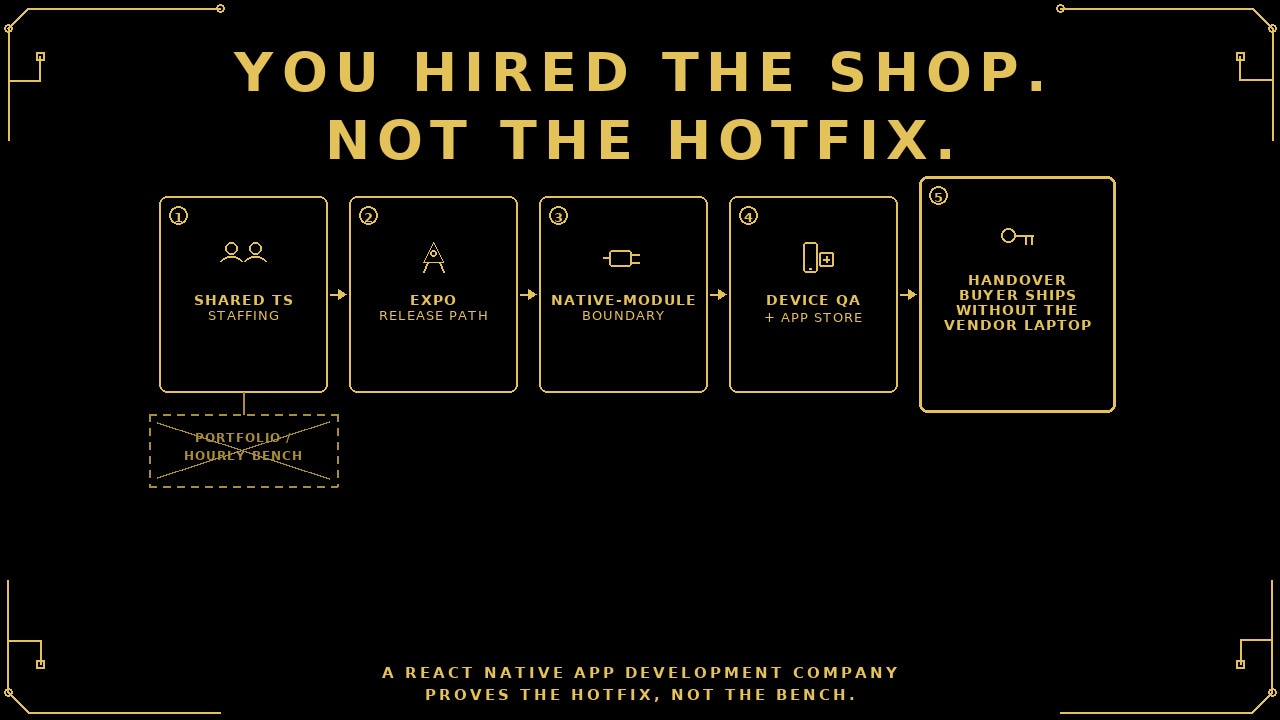
What a React Native App Development Company Must Prove on a Live Mobile Bet
A React Native app development company is the firm that can still ship a hotfix after you have the repo. I look at shared TypeScript staffing with the web team, the Expo release path, the native-module boundary, device QA, App Store ownership, and a handover that does not need the vendor laptop. I am not scoring portfolios.
Buyers who search this phrase get a how-to-choose listicle or an offshore service page. I write this page for the PE operating partner and the mid-market founder who already hired a shop, or is about to, and still cannot name the person who can cut a store build on Monday.
The selection criteria below are the vendor test. The rest of this page is the live-bet proof. Use both. Do not treat a portfolio as either one.
What does a React Native app development company have to prove?
The phrase sounds like a category. It is a test.
I do not start with headcount, hourly rate, or a wall of App Store screenshots. I start with the objects that decide whether a buyer engineer can ship if the vendor does not take the first call.
- One TypeScript bench that already ships the website, not a rented React Native lane
- An Expo project and an EAS pipeline a second person can run
- A named native-module boundary, with an owner, for the work JS cannot do
- Device QA on the phones the customer actually holds
- Apple and Google credentials in an org the buyer still has next quarter
- A handover that puts the hotfix on a buyer laptop, not a vendor one
If the shop cannot walk those, you bought a bench. You did not buy a company.
A mobile app development company page will still ask whether you even need mobile. A cross-platform company page will still ask iOS plus Android versus two native teams. This page assumes that call is made. The remaining question is whether the React Native shop can leave you a release.
When the website has to ship from that same repo, React Native Web is the named file. One codebase for web and mobile, not a second site beside the app.
Why is shared TypeScript staffing with web the first test?
React Native is a staffing decision before it is a framework decision. I already wrote that as React Native vs Flutter. The company test is narrower.
If the website already ships in React or TypeScript, the same people should be able to read the mobile repo. When that website is Next.js, a Next.js agency fits only if that same bench can open the mobile repo. Not "a mobile guild we can staff." The same people. A shop that brings a separate React Native bench, then tells you the web team will "pick it up later," is selling a second hiring lane. That lane is what you inherit when they leave.
I ask three questions in the first working session.
Who on the current roster can open the Expo project this week. Who can change a TypeScript screen and get it onto TestFlight without a contractor. What happens to that path if the vendor seat is empty in 90 days.
If the answers point at a TypeScript team you already pay, the shop is an accelerant. If the answers point at three contractors who only exist inside the vendor Slack, the shop is a lock-in. The product argument is the next section. This paragraph is the roster argument.
I do not hire a React Native company to invent a mobile department you cannot staff. I hire one that writes into the language the web team already owns.
Why use React Native for the product itself?
The roster test above is who can open the repo. The product reason to use React Native is narrower.
It fits when you need one product experience on iOS and Android, a shared codebase instead of two native teams, and a path to a native module when a camera, a map, a payment SDK, or a heavy interaction cannot stay in JavaScript.
Used well, that cuts duplicated work without giving up a native escape hatch. It does not mean React Native solves every mobile problem. A partner who will not name the tradeoff is a red flag, the same as a timeline promised before discovery, no plan for who owns the app after launch, or a vague answer on testing and releases.
A practical first 90 days, when the scope is a new app rather than a rescue, looks like this. Days 1 to 14 are discovery, architecture, and the success metric. Days 15 to 45 are the core build, a design-system foundation, and the CI pipeline. Days 46 to 75 are QA, analytics, and a beta. Days 76 to 90 are the production launch, monitoring, and the next roadmap. Integrations with a CRM, an ERP, or a legacy API stretch that. Skipping discovery pushes the broken assumptions into the first build weeks.
What does the Expo release path have to look like on Monday?
Expo is not a logo on the proposal. It is the path from a one-line JS fix to a tester phone, and from a native change to a store build.
Monday, 9:40. A buyer engineer clones the repo. They sign into an EAS account the company owns. They run the profile that already shipped last week. A JS change goes out on the update channel the shop documented. A native change cuts an iOS and Android binary the store will accept. Nobody DMs a contractor for the eas.json that only exists on one laptop.
That is a pass. A green build on the vendor MacBook is not a pass.
I open the objects.
The Expo project. Whose org. Whose slug. Whether a buyer email can open it.
EAS. Preview, production, and the update channel. Whether the credentials are in the company secret store, or in a vendor 1Password the buyer will lose.
The last store build. Who pressed it. What they clicked. Whether that person will still pick up.
A shop that "uses Expo" and still ships from a bare React Native repo with a private Fastlane that only their CI understands has not given you a release path. They have given you a story. React Native performance can wait until a second person can ship a slow screen. Tuning a binary only the vendor can cut is theatre.
Where is the native-module boundary, and who owns it?
Every mid-market React Native app hits a wall the JS layer cannot cross. Payments with a native SDK. Offline maps. A Bluetooth device. A background location rule the store will reject if you fake it. Push that has to land when the app is killed.
The company names that wall in week one. They write the module list. They name the person who will own the native side after handover. They do not say "React Native handles everything" and then surprise you in week nine with a Swift file nobody on the buyer side can compile.
I treat the boundary as a finding when it is missing.
- A feature that needs a native module, with no owner and no estimate
- A third-party native SDK pinned to a vendor fork
- An Expo config plugin that only builds on one machine
- "We will eject if we have to" with no one who has ejected before
Ejecting is not a plan. It is a rewrite you have not priced. A shop that cannot say which features stay in JS, which sit behind a config plugin, and which need a native owner is not a React Native app development company. It is a UI bench.
I write the boundary as objects. The module. The plugin. The person. I do not write "native capability" as a slide.
Who runs device QA and who owns the App Store?
Device QA is not a TestFlight link in Slack.
I want the phone matrix the customer actually holds. Low-end Android. The iPhone the field team will not replace. The tablet the warehouse already bought. A shop that only demos on the latest Pro, then calls that QA, is selling a screenshot.
I also want the store.
Apple Developer and Google Play sit in an org the buyer can open after the vendor leaves. The listing, the signing certs, the EAS credentials, the support email, the tax profile. If any of those are a personal Apple ID or a vendor Play account, you are renting the store. That is the same class of finding I write when a SaaS tenant still belongs to a founder. Different surface. Same Monday.
A shop that says "we handle submission" and cannot put the buyer on the team is not handling submission. They are holding the keys.
I screenshot the team page. I do not accept "we will transfer it at launch." Transfer is a project. Own it from the first build.
What does handover look like so we can ship without their laptop?
Handover is the product. The app is the artifact.
I sit a buyer engineer on a clean machine. They clone. They sign in. They ship a one-line hotfix to TestFlight, or they do not. If they need the vendor laptop, the VPN the shop did not document, or the Apple ID in a contractor's phone, handover failed.
The receipt is short.
- Repo in a buyer org, not a vendor GitHub
- Expo and EAS in a buyer org
- Store listings and signing in a buyer org
- A runbook a second person followed once, on camera or in the room
- The last production release repeated without the person who pressed it the first time
A Loom and a Notion page are not handover if the second person still cannot ship. Documentation that says "ping Alex" is a holdback candidate, the same way a pipeline that only goes green on one MacBook is a holdback candidate in software due diligence.
I do not score the shop on how polished the demo looks. I score them on whether the buyer can ship the next hotfix. That is the company.
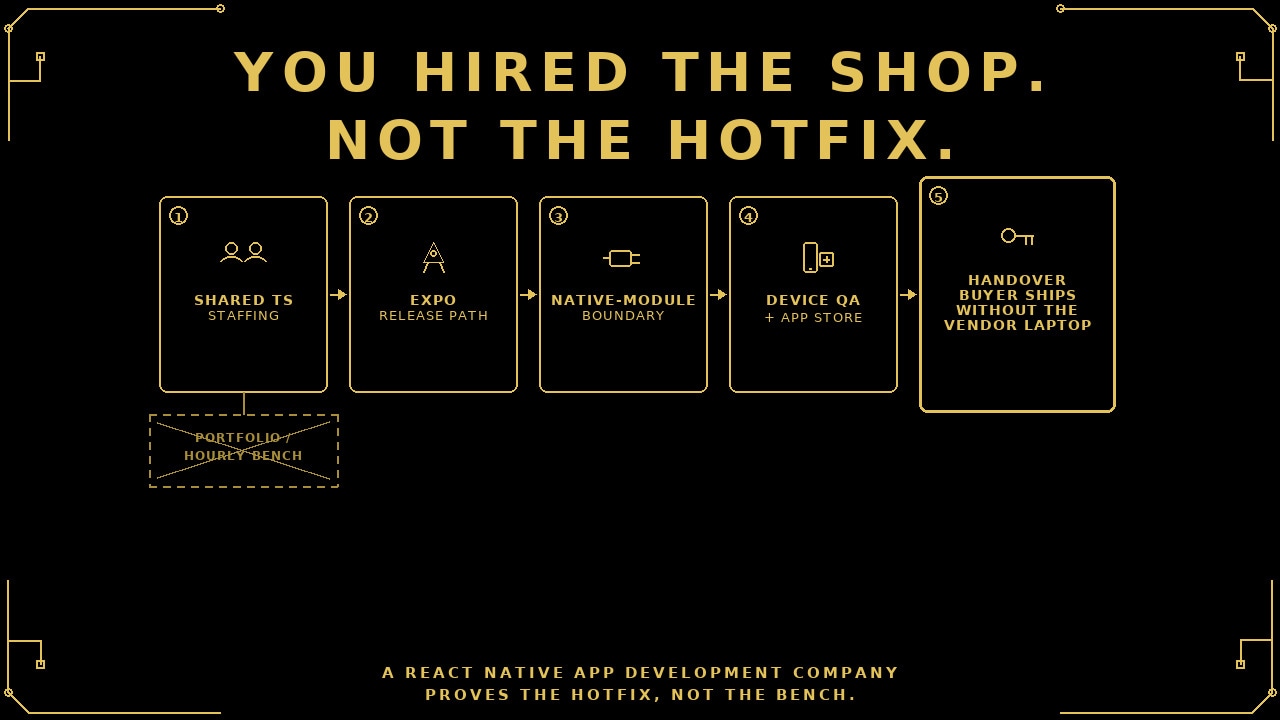
The diagram is the finding. Shared staffing. Expo release. Native-module boundary. Device QA and the store. Handover. That chain is a company. The portfolio and the hourly bench are the side path.
When do I hire the Fractional CTO seat versus a build sprint?
I hire the seat that matches the hole.
If the company needs the same person to own the stack call, the store, and the handover week to week, that is Fractional CTO, pause or cancel any month.
If the work is a real React Native and Expo ship, that is AI-Native Build on the React Native + Expo service. Same operator from the working session to the first store release the buyer can repeat.
If a live PE file includes a mobile repo you have to price before IC, that is Technology Diligence, 10 business days from data-room access.
Those are the live fees. This page does not invent others.
The Starter Workflow Pilot, 7 business days, is a later wedge if you only want one proof workflow after the operating model is set. It is not the hero offer for a mid-market mobile bet.
I run this as owner-led work. Strategy plus engineering in the same seat. Not a body shop that vanishes after the listing goes live.
If you have a portco or a mid-market app that still needs the vendor laptop to ship, start in chat or see the PE engagements. Bring the Expo project. I will sit on a clean machine and try the hotfix.
Mid-market selection criteria
The live-bet test above asks whether you can ship after the vendor leaves. Use these criteria before you sign, while you are still choosing the company.
- Outcome-driven discovery. Week one defines the core user journey, the v1 boundary, and the success metric. A feature checklist is not discovery. If the team needs a structured pass first, use a software discovery workshop.
- Native platform depth. Push notifications, deep linking, offline behavior, device permissions, and store release workflows. Not only JavaScript screens.
- Performance discipline. Startup time, list and animation performance, bundle size, and a regression check. Slow lists are an architecture problem. The React Native performance guide is the benchmark.
- Integration readiness. A plan for API contracts, retries, auth, and telemetry against the CRM, ERP, billing, and support systems you already run.
- Delivery cadence. Weekly demos, acceptance criteria, explicit risks, and a fast escalation path. Vague status is execution risk.
- QA and release management. Unit and integration tests, device smoke tests, a beta track, a release checklist, and a rollback.
- Security basics. Token handling, transport security, data minimization, and role-based access on admin flows. Not a phase after launch.
- Post-launch support. The bug-fix process, the enhancement cadence, and handover docs, written before the contract is signed.
A vendor that only sells speed and a low hourly rate is carrying delivery risk. Timeline still moves with the number of integrations, the security bar, and whether scope is locked before build.
If the web surface is a portal, put a Next.js partner in the same evaluation. If you need a faster proof before the full rollout, use the MVP weekly receipt.
What do I take into the next operating meeting?
I take the objects that decide Monday. I stop.
The TypeScript bench that can read the repo. The Expo path a second person ran. The native-module list with an owner. The phone matrix. The store team page. The hotfix that shipped without the vendor laptop.
If those are clean, the portfolio can wait. If they are not clean, the portfolio does not matter yet.
I do not ask the shop how they feel about the sprint. I ask a buyer engineer to ship a one-line change. Either it lands or it does not. If it does not, keep the cash. The screenshots will still be in the deck.
Related reading
Frequently asked questions
What is a React Native app development company?
A React Native app development company is the firm that can still ship a hotfix after you have the repo. I look at shared TypeScript staffing with the web team, the Expo release path, the native-module boundary, device QA, App Store ownership, and a handover that does not need the vendor laptop. A portfolio and a bench are not that proof.
How do selection criteria differ from the live-bet test?
Selection criteria are what you ask before you sign. Discovery tied to an outcome, native platform depth, performance discipline, integration readiness, a weekly cadence, device QA, security basics, and support terms. The live-bet test is whether a buyer engineer can ship a hotfix after the vendor leaves. Both sit on this page.
What should you look for when evaluating a React Native development company?
Start from the business outcome rather than a feature list. Look for production experience with push notifications, deep linking, and store releases, a device-level QA process, and post-launch support terms written before you sign. A vendor that only sells speed and a low hourly rate is carrying delivery risk.
What must they prove before I trust them with a live mobile bet?
Five objects. One TypeScript bench that already ships the website. An Expo release path a buyer engineer can replay. A named native-module boundary with an owner. Device QA on the phones the customer actually holds. App Store and Play Console credentials the buyer can open without texting the vendor. If any of those sit on a contractor laptop, you hired a shop. You did not hire a release.
Who should own the App Store listing and the Expo project?
The buyer. The Expo project, the EAS account, Apple Developer, and Google Play should sit in an org the company still has after the vendor leaves. A shop that ships from a personal Apple ID or a vendor EAS team is renting you a store listing. That is a finding, not a preference.
When do I hire Fractional CTO versus a React Native build sprint?
Hire Fractional CTO when the company needs the same person to own the stack, the store, and the handover week to week. Hire AI-Native Build when the work is a real React Native and Expo ship. A later single proof workflow is the Starter Pilot. That is not the mobile-bet buy.
Why do mid-market teams choose React Native over separate native iOS and Android apps?
React Native keeps one shared codebase and one product behavior on iOS and Android, which cuts duplicated engineering and a second native team. Native modules stay available when a feature needs the platform. The tradeoff is favorable only when the same TypeScript bench can still ship after the vendor leaves.
What are the red flags when hiring a React Native development company?
A timeline promised before discovery. No plan for who owns the app after launch. A vague answer on testing and releases. No example of an app that grew past the first version. And a claim that React Native solves every mobile problem without naming a tradeoff.
Written by Anthony Wentzel