
Technology Leadership
What Is a CTO of a Company
Published Oct 30, 2026
A CTO of a company is the chief technology officer. The seat owns technology decisions a startup, mid-market firm, or PE-backed company still lives with.
What Is a CTO of a Company
A CTO of a company is the chief technology officer. What's a CTO, in the sentence I use with operators: the person who owns the technology decisions the business will still have to live with next year. CTO stands for chief technology officer. The letters take ten seconds. The seat is the rest of the conversation, and it is not the same job at a startup, in a mid-market company, and inside a PE-backed portco.
I write this for the CEO, the operating partner, or the founder who has been handed the title and is now being asked what the person would actually do. I have sat in that seat. I build the systems the seat is supposed to be deciding about. The pages that rank for the phrase are mostly a dictionary line plus a list of soft skills. The question in the room is narrower. Who is allowed to make a call the company cannot cheaply undo.
This page is the definition. What a fractional CTO owns for mid-market and PE portcos is the hub above it, for the case where the decisions are real and a full-time officer is more seat than the company needs. I will not retell that page here. If the open question is the wage comparison, the business case for a fractional seat against a full-time wage holds it, and the fractional CTO cost calculator runs the days you actually need. I will not put a rate on this page.
What does a CTO of a company actually do?
A CTO owns a short list of calls. I keep the list where a board can hear it, because a job description that says "drive innovation" is how the seat becomes a meeting.
What gets built, what gets bought, and what stops. The architecture call. The vendor that has become the only way a workflow runs. The custom build that should have been a product you rent. Someone has to be allowed to say stop, in writing, while the project still has a sponsor.
What the board hears. What changed, what is blocked, and which decision is theirs this month. A stack diagram is not that memo. A status that says "on track" with no blocked decision is not that memo either.
Who gets hired into the technical leadership, and who does not. The next engineering manager. The staff engineer the team will route around. Reference calls on a senior hire, so the company is not buying a title. The CTO does not have to run every interview. The CTO does have to own the miss.
Which risk is allowed to stay. A single person who can ship the release. A vendor who can hold the company still. A system the board reports from that nobody inside can explain. The seat is the person who puts that risk in a sentence a non-engineer can repeat.
Day to day tickets, standups, and the release of the week are not the list. Those belong to the people who run the team. If the CTO's calendar is only those, the company has a senior manager with an officer's title, and the decisions above are being made by whoever is loudest in the deal.
What a CTO does at a startup
At a startup the CTO is often the first builder. They pick the stack. They hire the first few engineers. They are still on the incident. That is a real job, and it is easy to confuse with the seat.
The test I use is boring. Can the company ship a normal week when this person is in a sales meeting, on a plane, or out sick. If the answer is no, you have a founder-engineer the company depends on. Give them the title if you want. Do not pretend the officer's job is being done. The officer's job, even this early, is the call that will still be true when there are thirty people: what you will not build, which interface you will not break, and who else is allowed to deploy.
I have watched the title arrive the week a round closes, because a board wanted an officer on the slide. The work did not change. The person was still the only one who could ship. The useful move is not a new job description. It is one second person who has shipped without them, and one decision written down that the team can execute while they are out. Until that exists, "CTO" is a name for the bottleneck.
What a CTO does at a mid-market company
A mid-market company already runs. Customers are live. Finance closes. There is usually a team that can execute, and a pile of vendors that arrived one renewal at a time. The CTO is no longer the first commit. The CTO is the person who can stop a commit that should not happen.
The work I see in that seat:
The architecture is already a fact. The job is which part of it is allowed to grow, and which part is a trap the next feature will make permanent. A rewrite proposed as a mood is not a decision. A rewrite with a system that stays in production, a team that can run both, and a date the old one dies, is a decision.
Vendors have concentration the org chart does not show. Billing, identity, support, the data tool, the cloud account. The CTO can name the one that would stop the company, and can fire it or accept it. "We would figure it out" is not acceptance. Acceptance is a sentence.
Hiring is about the layer the team does not have. Strong engineers and no one who will make the call is the usual shape. The CTO hires that layer, or admits they are the layer, and then the calendar has to match.
The board memo gets shorter, not longer. Mid-market boards do not need a platform tour. They need the blocked decision and the risk that got worse. If the CTO cannot write that in a page, they are still collecting diagrams.
Engineering managers run the week. That sentence is the whole design. A CTO who takes the week back will be good at the week and absent from the calls only they can make.
What a CTO does at a PE-backed company
A PE-backed CTO works on a clock the startup CTO does not have. The hold period is the calendar. Diligence already happened, or it should have. The findings are now a list, and an add-on can arrive with a second stack before the first list is done.
The seat here is translation. A finding becomes a sequence the company can run without stopping the business that was just bought. What is the platform standard. What stays local because the customers are local. What the operating partner hears before the next investment committee, in a sentence that is not "integration is complex."
Key-person risk is part of the job. The target often has one engineer, one admin, or one analyst who knows how the number is actually produced. The CTO's first duty is not a vision deck. It is whether that person is still the only copy of the system, and what gets written down while they are still in the building.
Add-ons are where the title gets tested. Each company arrives with a CTO, or with someone who has been acting as one. Two officers and one platform is a political problem disguised as an architecture problem. Someone has to decide whose stack is the survivor for the thing the board will look at, and whose team runs the week on the system that remains. That call is the seat. A steering committee that "aligns" for a quarter is the call being avoided.
I do not pretend one person does diligence, integration, and the product roadmap as a single hero. Technical due diligence is a different read, done before close, when a finding can still change the deal. After close, the CTO inherits whatever that read did or did not catch. If nobody did the read, the first hundred days become the read, after the wire.
How a CTO differs from a CIO
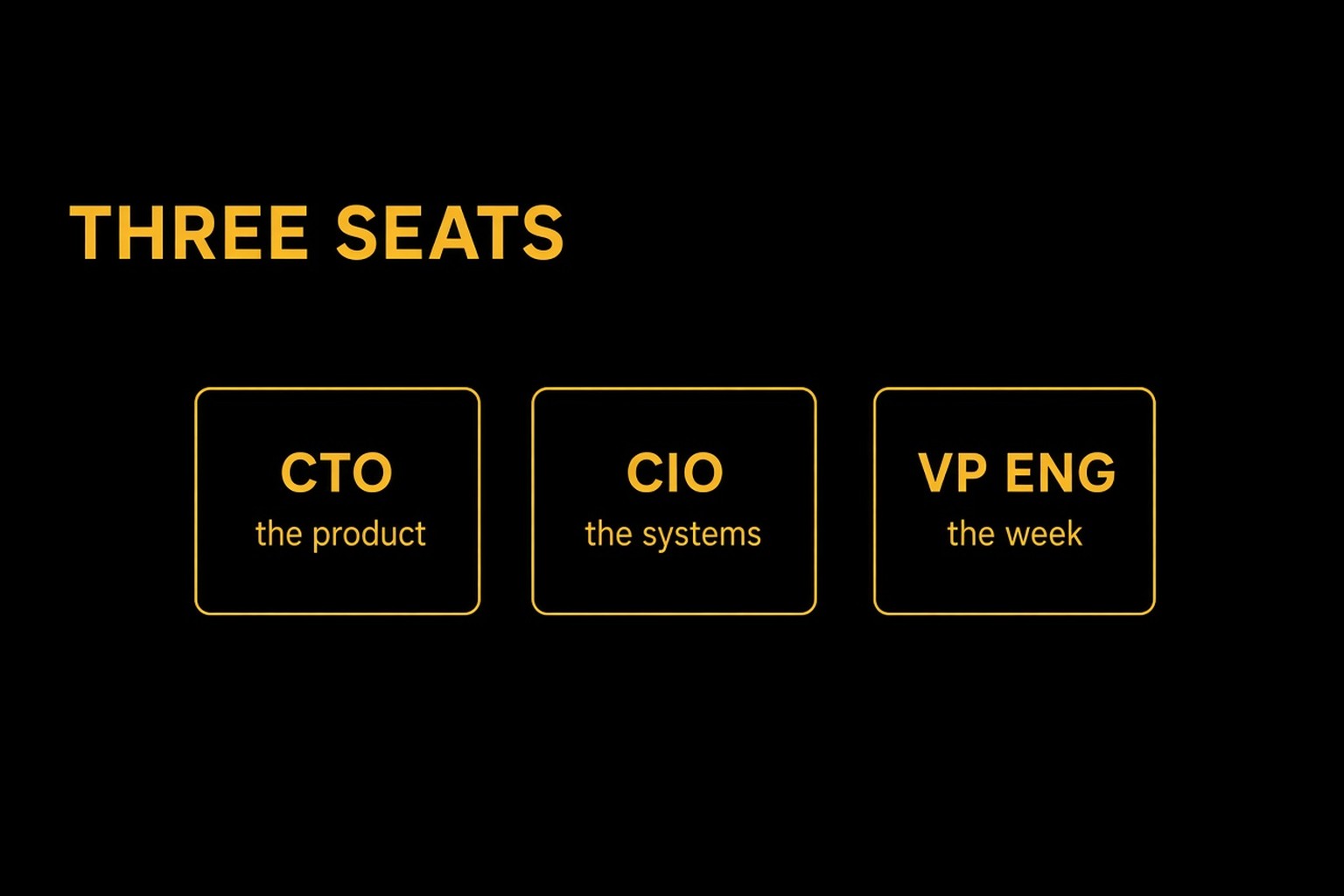
A CIO owns the operating stack the business runs on. Which system is allowed to answer a reported number. Who holds admin on identity and on finance. Which vendor can be paused. The control around data an agent might later read. The product roadmap is not that job. The mobile framework is not that job.
A CTO owns the product and the way it is built. What the company sells, how it is architected, what the engineering org can take on, what the board is told about technical risk in the product. The payroll system is not that job, unless the product is payroll.
Companies mix them because both titles have "chief" and "technology" in the vicinity, and because the pain arrived with the wrong name. Two official numbers and a shared admin login are a CIO-shaped gap. A product nobody can change, and a roadmap that is a list of favors, are a CTO-shaped gap. What a fractional CIO owns when the gap is systems, identity, and the reported number is the sibling page for that split. I sit on the product side of it. I will not pretend the two seats are a branding choice.
If you hire a CTO and the blank line was the ERP admin, you will get architecture opinions and the admin problem will still be there on Friday. If you hire a CIO and the blank line was the product, you will get a vendor review and the build will still be stuck.
How a CTO differs from a VP of Engineering
A VP of Engineering owns the team that ships the week. Hiring the people who write the code. The process that gets a change to production. The on-call. The manager layer. The quality of the week after week delivery. That is a full job, and it is not the officer's list above.
The CTO points at what the week is for. The VP makes the week happen. In a small company one person wears both, and the week wins, because the week is loud. The decisions wait. That can be the right compromise for a year. It is a compromise. Name it. The moment the roadmap is whatever the loudest customer asked for last Tuesday, the officer half of the job has gone quiet.
A company does not need both titles on day one. It needs both jobs named, even if one person holds them, so you can see which one is starving. I would rather see "VP of Engineering, and the CTO calls are still the CEO's" than a CTO title on someone who has not been given permission to stop a project.
When a company needs a full-time CTO
Hire a full-time CTO when the decisions on this page need a person every working day, and the company can keep them. Technology is the product, the calls do not fit in a shared calendar, and a board, a regulator, or a customer contract wants a named officer who is not splitting the week.
A second reason is overflow. The work has been spilling out of a part-time arrangement for more than a quarter. Managers are waiting on calls. Vendors are renewing without an owner. The board memo is late because nobody's job is the memo. That is a full-time shape. Plan the hire. Do not discover it as a surprise in month fourteen of a retainer that was never sized for it.
The third reason is the one people skip. The permanent org is already known. You are not in a search because someone left yesterday and the deal closes Friday. You know the seat, you know the team under it, and you are ready for a person who stays. How to choose an interim CTO versus a full-time CTO is the sibling for that timing. If the permanent shape is still a guess, a full-time search is how you freeze the guess into a compensation package.
When a fractional or interim CTO is the better shape
Use a fractional seat when the decisions are the ones on this page and they are not a full week. Same person, week to week. Architecture, vendor, hiring, the board memo. The company does not yet need an officer in the building every day. The hub page is the description of that seat. This page stops at the distinction, so it does not become a second services page.
Use an interim seat when the need is a window. Someone left. A deal is in motion. A program is stuck and the permanent design of the org is still open. The person is embedded until the window ends. Seniority can match. The calendar does not. Interim is one company and an end date. Fractional is ongoing coverage that does not fill the week.
Do not use either title as a way to avoid the definition. If you cannot say which decisions are vacant, you will hire a mood. Write the vacant decisions first. Then pick the shape that matches how often those decisions happen, and whether they have an end.
I will not quote a rate, a range, or a retainer figure here. The comparison against a full-time wage, for the days you need, is on the business case page and in the calculator. If you already know the decisions and you want a person to look at them with you, start in chat.
What this page will not do
I will not give you a competency matrix, a sample job posting, or a salary band. Those are hiring tools, and they are how this question gets skipped. A posting can be perfect and the seat can still be empty, because nobody named the decision the person is allowed to make.
I will not rank tools, and I will not tell you to become a CTO by learning a framework. The framework is not the seat. The seat is the call the company will still be living with when the framework has been replaced.
If the gap is the operating stack rather than the product, you are on the wrong page. If the gap is the team that ships the week, you are on the wrong page. If the gap is the decision, you are in the right room. Name it before you name the title.
Related reading
Frequently asked questions
What is a CTO of a company?
A CTO of a company is the chief technology officer. The seat owns the technology decisions the business will still live with next year: what gets built or bought, what the board hears, and who is hired to carry the work. The letters are the title. The seat is those decisions.
What does CTO stand for?
CTO stands for chief technology officer. What's a CTO, past the abbreviation, is the officer accountable for technology decisions. It is not a nickname for the most senior engineer in the room, and it is not a second name for the person who runs the help desk.
What does a CTO do at a startup, a mid-market company, and a PE-backed company?
At a startup the CTO is often still building, and the seat is real when the company can ship without them in the room. At a mid-market company the CTO owns architecture, vendors, hiring, and the board memo, while engineering managers run the week. At a PE-backed company the CTO turns diligence into a sequence the hold period can absorb, including add-ons that arrive with their own stack.
How is a CTO different from a CIO and from a VP of Engineering?
A CTO owns the product and the engineering calls. A CIO owns the operating systems, identity, vendors, and the number the company reports. A VP of Engineering owns the team that ships the week. Three gaps. Three seats. One title stretched across all three leaves two of the jobs vacant.
When does a company need a full-time CTO instead of a fractional or interim CTO?
A full-time CTO fits when those decisions need a person every day, or when a board or a contract requires a named officer. A fractional seat fits when the decisions are real and they are not a full week. An interim seat fits when a departure, a deal, or a stalled program needs a named person now and the permanent shape is still open. This page defines the seat. It does not price it.
Written by Anthony Wentzel