
Technology Leadership
What a Fractional CIO Owns, and When You Need One
Published Oct 28, 2026
A fractional CIO owns systems, identity, vendors, and the reported number for a mid-market or PE firm that does not need a full-time seat.
What a Fractional CIO Owns, and When You Need One
A fractional CIO is one senior operator who owns the systems, identity, vendors, and reported numbers a company runs on, on a part-time schedule, when a full-time information officer is more seat than the company needs. For a mid-market or PE portfolio company, the test is whether those calls have a name. Title is optional. Ownership is not.
I sit as fractional CTO. I build agentic systems and custom software for PE and mid-market companies. Pineapples does not offer a fractional CIO. Buyers still ask for the title, usually because the pain is real and the name they were given is the wrong one. This page is the distinction I use in that conversation.
What is a fractional CIO?
A fractional CIO is a senior operator on a part of the week, the same person every week, whose object is the company's operating technology. The ERP, the identity provider, the finance export, the vendor that holds customer data, the admin login nobody inside can reset. The job is to make those calls and to leave a name on them.
It is not a help desk. It is not a project manager for a software implementation. It is not a rotating cast of specialists who each know one system. If the seat changes people when the calendar changes, you bought staff augmentation.
The full-time version of the job is a chief information officer. Mid-market companies and PE portfolio companies often need the calls without needing the seat every day. That is the fractional shape. The published comparison of a fractional technology seat with a full-time wage, using public labor statistics, is the business case for a fractional CTO. I am not repeating those figures here. They are not a Pineapples price, and this page does not discuss rates.
What does a fractional CIO own?
Four things. If a proposal cannot name them, it is a different job wearing this title.
The system of record for the numbers the business reports. Which system is allowed to answer revenue, pipeline, inventory, or the customer count. If two leaders can pull two official versions, the seat is empty, whether or not someone has CIO in an email signature.
Identity and access. Who can get in, who holds admin, what happens when a token, a vendor login, or a domain sits with a person who is leaving. The failure mode is operational. People notice when the report is wrong or the user is locked out. They notice late.
Vendors the company cannot casually leave. The contract, the admin, the export, and the right to pause. A provider who is the only one who can reset access is a concentration risk. The fractional CIO's job is to put a person inside the company on that switch.
The sequence before AI spend. An agent reads whatever system you point it at. If the source, the owner, and the control are blank, the agent will pick a row and sound sure. That decision is data strategy consulting. A fractional CIO owns the decision when the systems are the operating stack. The CIO does not get to skip it because a model demo went well.
What the seat does not own: the product roadmap, the engineering hiring plan, and the architecture of software you are building to sell. Those are CTO calls. I will separate them below with a file I actually built.
What do fractional CIO services include?
Fractional CIO services are the month-to-month work behind those four lines. I describe the work. I do not describe a Pineapples offer, because we do not sell this seat.
A written source map. For the numbers the board already sees, which system wins, and what happens to the other export.
Identity and admin brought inside. Domains, identity provider, finance admin, and the vendor logins that can lock the company out. Someone on the payroll can pause each one.
A monthly note. What changed, what is blocked, and which decision the CEO or the operating partner has to make. Outcomes, not a tool inventory.
A refusal list for new systems and for AI. What will not be bought this quarter, and which workflow waits until the source of record is one thing.
Vendor calls with a name on them. Renew, cut, or keep, with the person who has to live with the cut still in the room.
Tickets, password resets, and the daily queue stay with the managers and the providers who already run them. If the fractional seat is in that queue, the scope has drifted. Hire the manager. Put the fractional scope back on decisions.
A good engagement can also tell you that you do not need the seat for long. Interim CTO versus full-time CTO is the same judgment on the technology-leadership side: cover the calls, then decide whether a permanent hire is even the shape. A fractional CIO who cannot describe the full-time job they are bridging is renting the title.
Fractional CIO vs fractional CTO vs fractional chief AI officer
These three get bundled in a search because they are all part-time senior seats. They are not substitutes.
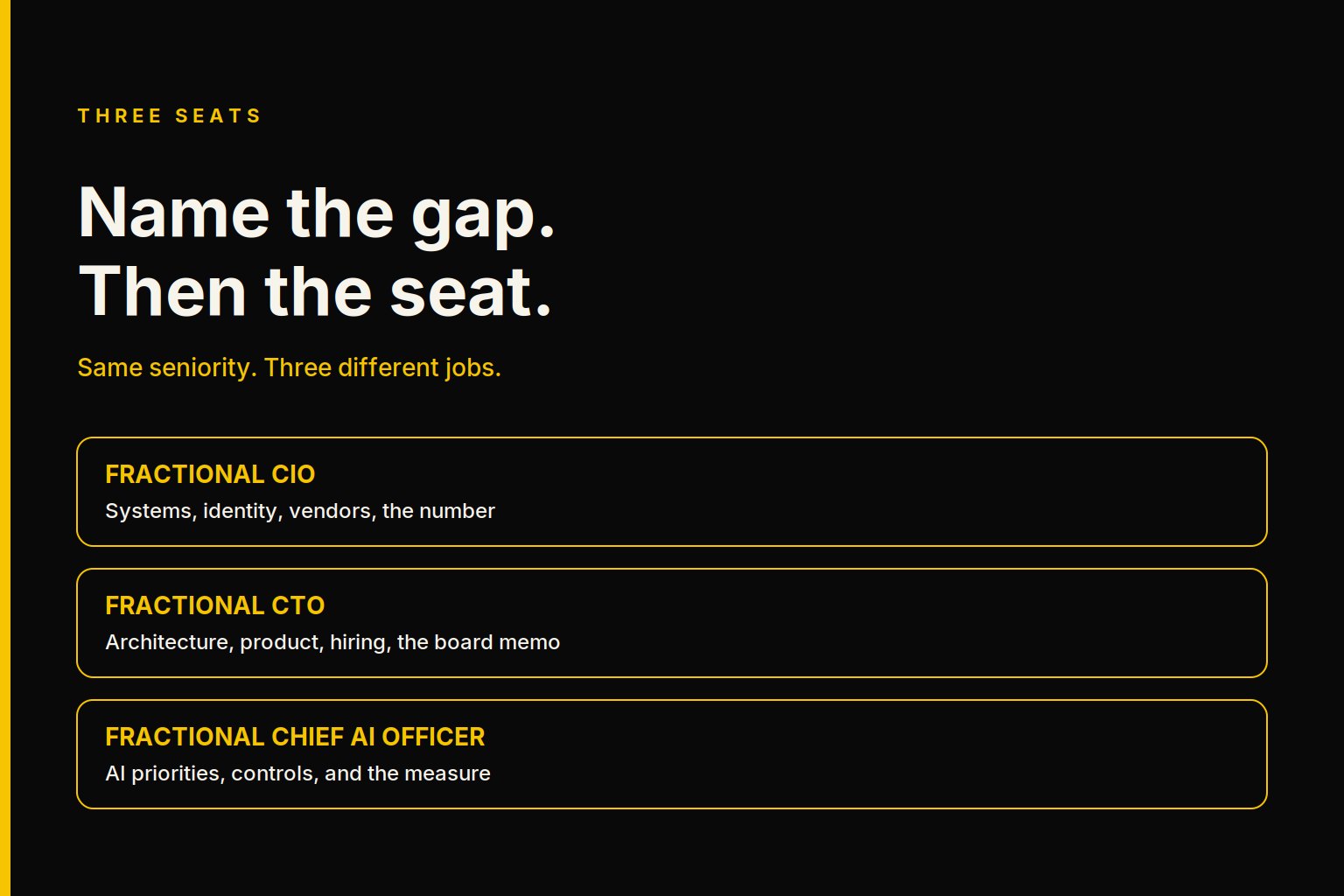
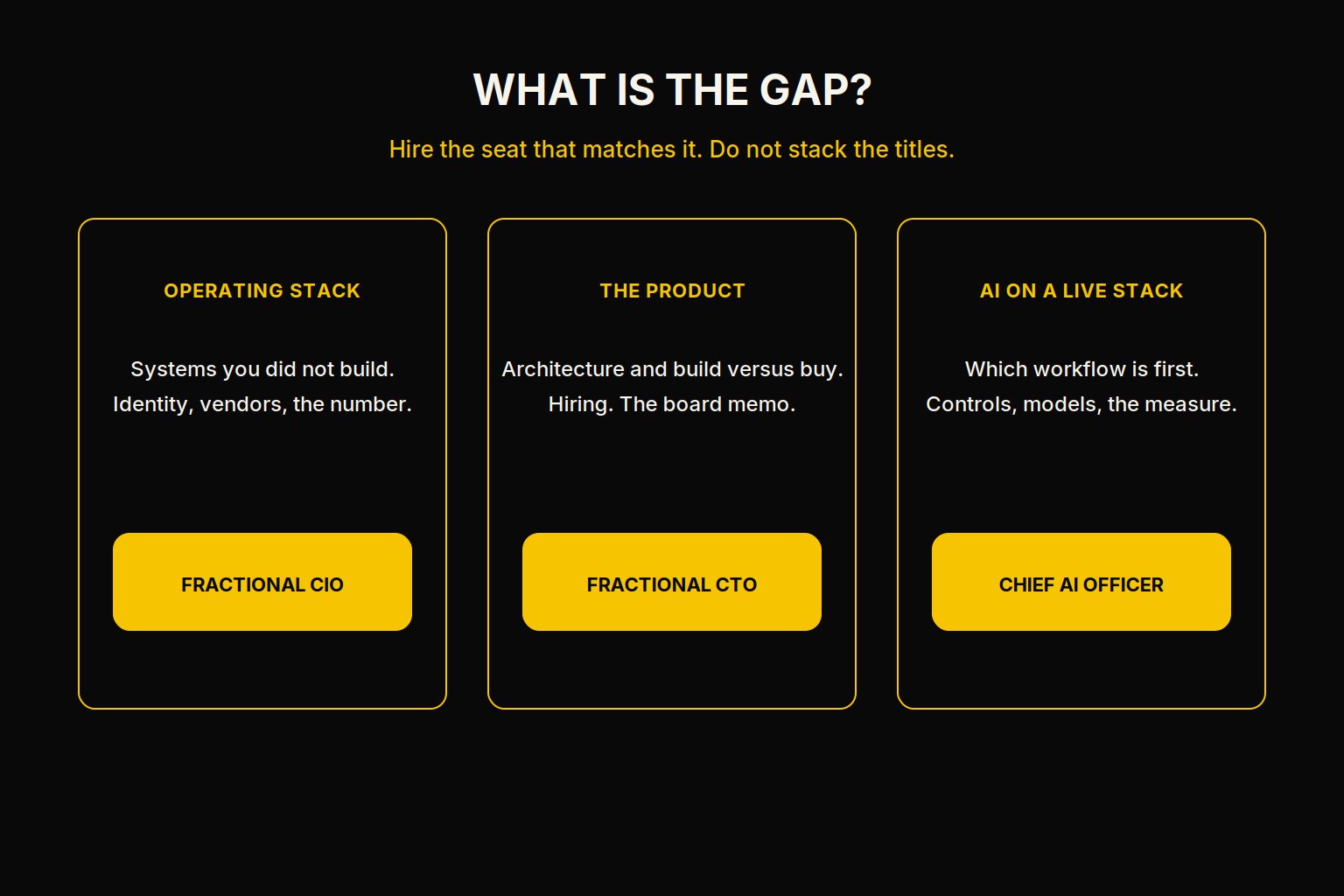
Fractional CIO. The company runs on systems it did not build. The gap is the operating stack, identity, vendors, and the reported number. The product, if there is one, is not the open question.
Fractional CTO. The product is the company, or the portfolio needs architecture, build versus buy, hiring, and a board-ready technology memo. I hold this seat. The services page is fractional CTO for mid-market and PE portcos. Same person week to week. Not a rotating bench.
Fractional chief AI officer. The stack is already stable enough to run the business. The open question is which AI workflow is first, what the data controls are, which models and vendors are allowed, and how you will know the number moved. That service is a fractional chief AI officer. Use it when a technology lead is already in the building and nobody owns the AI calls.
A company can need one of these. It rarely needs all three at once. Stacking titles is how a thin bench pays for three seats and still has no name on the Tuesday miss.
The product call is the cleanest way I have to show the CTO side. A $3.4M React Native engagement for AT&T put at.tv and DirecTV on one codebase, with Expo and Expo Router on the web. That was an architecture decision about the product. It was not an information-officer decision about the buyer's ERP. I will not add a timeline, a headcount, or a savings figure on top of those facts. The point is the object of the work. A fractional CIO is not hired to pick the mobile framework. A fractional CTO is.
When does a mid-market or PE company need a fractional CIO?
Use the gap, not the org chart.
You are close to this seat when the business runs on an ERP, an identity provider, and a handful of vendors, and no executive owns them. The CEO is the tie-breaker for systems they do not have time to learn. Two versions of the monthly number are both treated as official. The managed service provider holds admin, and nobody inside can revoke it. An operating partner is the unpaid CIO of several portfolio companies and cannot keep doing it.
You are also close when someone wants to fund an agent and the data it would read has no owner. Fix that before the pilot. The data strategy page is the decision. The build, once the source exists, is how to build an AI agent for a business. A fractional CIO who skips that order and buys the agent has renamed the problem.
On a deal, the same gap shows up in diligence. Technical due diligence asks whether the system that runs can hold the thesis. A missing owner for identity, vendor admin, or the reported number is an operating fact, not a footnote. Hire the fractional shape after close if the finding is an empty seat and a full-time search would outlast the first hundred days. Do not hire it to decorate a data room.
You do not need a fractional CIO when a strong sitting CIO or CTO already owns these calls. You do not need one when the work in front of you is standups, ticket triage, or a single implementation project. You do not need one when the real gap is the product. Hire the CTO seat. You do not need one when the real gap is AI governance on a stack that already runs. Hire the chief AI officer seat.
What an identity failure taught me about the seat
I build a mobile identity app. I am not the company's fractional CIO. I am the builder, and the lesson is the class of failure, not a client logo. I will not name the company.
The session history screen failed for a user after the app sat open. Production logs showed every history request getting a 401 at the time of the screenshot. The screen and five other API calls sent the stored login token without checking its age. They never used the refresh token. Seven calls, one expired token.
We replaced those seven calls with one shared client. It refreshes before expiry, retries once after a 401, then signs the user out cleanly. The fix went to a single tester's build first. Nothing was merged for everyone. No over-the-air update went to other users.
That is a product defect, and the CTO-shaped call was to put one client in front of the seven calls instead of patching screens one at a time. The CIO-shaped reading is why the failure matters to an operator. Access looked fine until it quietly was not. The token was present. It was old. The system kept presenting it. Nobody owned the question "is this credential still the one we should send?"
I see the same shape inside operating companies, without a mobile codebase. A finance export that still runs because a password is saved in a browser. A vendor admin login that lives with a contractor who rolled off. A domain and an identity provider that nobody on the leadership team can recover. The fractional CIO is the person paid to own that class of call every week. The fractional CTO is the person paid to own the architecture of the product, which is the call I made on the shared client. Confusing the two is how you hire a builder to referee your ERP, or an information officer to design your app.
What to do if you asked for the wrong title
Write the gap in one sentence. Operating stack. Product. Or AI on a stack that already runs.
If it is the product, start with the fractional CTO page, and use the interim versus full-time guide if you are also deciding whether the seat should become permanent. If it is AI only, start with a fractional chief AI officer. If it is the operating stack, use this page as the job description and hire that shape from someone who actually sells it. We do not.
If you are unsure which sentence is true, start in chat. Bring the call that is stalling. I will tell you which seat it belongs to, including when the honest answer is that you do not need a new one.
Related reading
Frequently asked questions
What is a fractional CIO?
A fractional CIO is one senior operator who owns the systems, identity, vendors, and reported numbers a company runs on, on a part-time schedule. The company does not yet need a full-time chief information officer. The same person shows up week to week. A rotating bench is staff augmentation with a different title.
What does a fractional CIO own?
The seat owns the operating stack the business runs on. That means which system is allowed to answer a reported number, who holds admin on identity and finance, which vendors can be paused, and the control around data an agent might later read. It does not own the product roadmap, the engineering hiring plan, or the choice of mobile framework.
What do fractional CIO services include?
Fractional CIO services include a source-of-record decision, identity and access ownership, vendor admin that someone inside the company can pause, a monthly note on what changed and what is blocked, and the sequence before any AI workflow is funded. Day-to-day tickets stay with the managers and the providers who already run them.
How is a fractional CIO different from a fractional CTO and a fractional chief AI officer?
A fractional CIO owns the operating stack, identity, vendors, and the reported number. A fractional CTO owns product architecture, build versus buy, engineering hiring, and the board technology memo. A fractional chief AI officer owns AI priorities, governance, model and vendor choice, and measurement, on a stack that already runs. Same seniority. Three different gaps.
When does a mid-market or PE company need a fractional CIO?
Hire the shape of the seat when the company runs on systems it did not build, two leaders can pull two official numbers, vendor admin sits with an outside provider and nobody inside can pause it, or an operating partner has become the unpaid information officer across a portfolio. If the gap is the product, hire a fractional CTO. If the gap is AI on a stable stack, hire a fractional chief AI officer. Pineapples does not offer a fractional CIO seat.
Written by Anthony Wentzel