
Technology Leadership
Our AI call recap read 40,000 of 67,245 characters and said nothing. What a fractional chief AI officer fixes first
Published Nov 25, 2026
Fractional chief AI officer: a 69 minute call of 67,245 characters was cut at 40,000, failed on the token limit, and said nothing. Failure has to be loud.

Our AI call recap read 40,000 of 67,245 characters and said nothing. What a fractional chief AI officer fixes first
The pre-call brief was there. The post-call recap was not.
A fractional chief AI officer makes a failed agent say so out loud. On our meeting recap platform, a 69 minute client call of 67,245 characters got its pre-call brief and no post-call recap. The read cut at 40,000 characters, about 59%, asked for one unstreamed reply, failed on the token limit, and the scheduler skipped it.
A fractional chief AI officer is the part-time executive who sets AI priorities, governance, and vendor choices, and who checks that a failed agent says so out loud.
The hub for fractional CTO, fractional CIO, and fractional chief AI officer leadership is fractional CTO for mid-market and PE portcos. The sibling on the same seat is fractional chief AI officer: we changed the order. The hired seat is a fractional chief AI officer. The CIO seat beside that hub is what a fractional CIO owns.
Silent failure, then a failure that says so
| Silent failure | Loud failure | |
|---|---|---|
| The read | Cut the record at 40,000 characters, about 59% of a 69 minute call of 67,245 characters. Asked for one unstreamed reply. Failed on the token limit. | Reads the whole record, up to 200k characters, in 28k parts with overlap. Streams each part. Keeps complete items from a cut-off reply. |
| After a failed read | A failed read was final and silent. The scheduler skipped any call that had a run row of any status. No post-call recap. Nobody told. | Retries a failed read once after 15 minutes. A watchdog alerts admins for any filed call with no recap after 30 minutes. |
| Task owner | A dry rerun was not sendable. The recap had named the person who asked as the owner of a task. | The owner is the person asked ("can you...") or the person who says "I'll...", else "Owner not stated". |
| The rest of the call | Dropped the last third of a call. | Stopped dropping the last third of a call, merges duplicates, and labels a figure over 60 days old as "last year, for comparison" so it never counts as a current goal number. |
877 unit tests plus 4 post-call end-to-end tests are green.
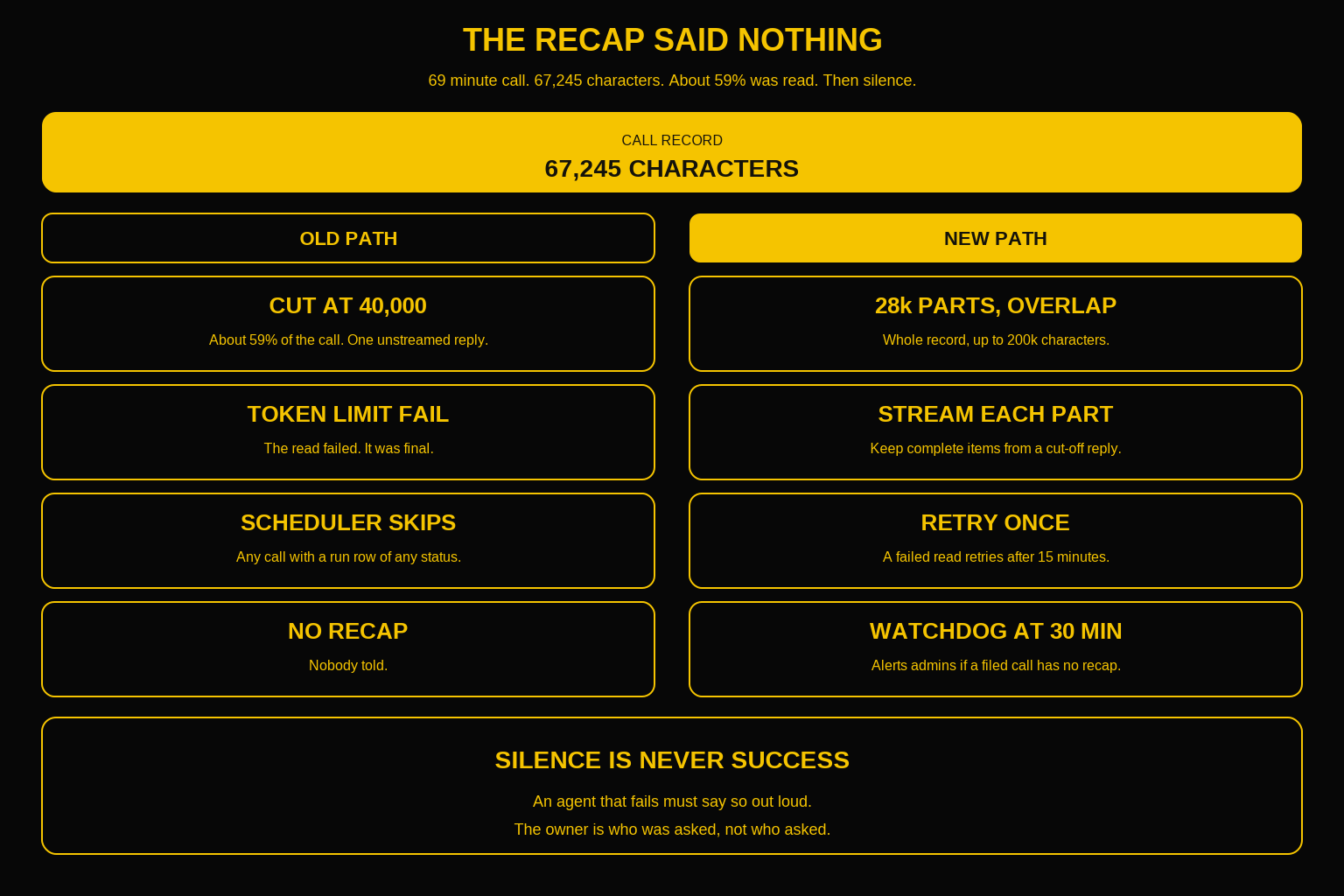
An agent that fails must say so out loud. Silence is never success.
What I want an agent rollout to do
An agent that fails must say so out loud. Silence is never success. Owners of commitments come from who was asked, not who asked.
Mid-market teams are buying AI note-takers and recap agents. A recap that quietly covers 59% of a call, or assigns a task to the wrong person, is worse than no recap. A chief AI officer's job is to make failure loud. That is what a fractional chief AI officer checks in any AI agent rollout.
The second fix came after a dry rerun was not sendable. The recap had named the person who asked as the owner of a task. The owner is now the person asked ("can you...") or the person who says "I'll...", else "Owner not stated". It also stopped dropping the last third of a call, merges duplicates, and labels a figure over 60 days old as "last year, for comparison" so it never counts as a current goal number.
When you do not need this
You do not need this check when a failed read already says so, the whole record is read, and the task owner is the person who was asked. A recap that covers about 59% of a call and stays quiet is the case that needs the seat.
If the open question is who owns the AI calls, start with a fractional chief AI officer. Talk to us.
Related reading
Frequently asked questions
What does a fractional chief AI officer check first in an AI agent rollout?
A fractional chief AI officer checks that a failed agent says so out loud. On our meeting recap platform, a 69 minute client call of 67,245 characters got its pre-call brief and no post-call recap, and nobody was told. A recap that quietly covers 59% of a call, or assigns a task to the wrong person, is worse than no recap.
What is a fractional chief AI officer?
A fractional chief AI officer is the part-time executive who sets AI priorities, governance, and vendor choices, and who checks that a failed agent says so out loud. The same seat is sometimes called a fractional AI officer or a fractional head of AI. The service page is https://pineapples.dev/services/fractional-chief-ai-officer
Why did the call recap say nothing?
The read cut the record at 40,000 characters, about 59% of the call, asked for one unstreamed reply, and failed on the token limit. A failed read was final and silent, because the scheduler skipped any call that had a run row of any status. The pre-call brief was there. The post-call recap was not.
What does the recap do when a read fails?
The read now takes the whole record, up to 200k characters, in 28k parts with overlap, streams each part, and keeps complete items from a cut-off reply. A failed read is retried once after 15 minutes. A watchdog alerts admins for any filed call with no recap after 30 minutes.
Who owns a task in the recap?
The owner is the person asked ("can you...") or the person who says "I'll...", else "Owner not stated". A dry rerun was not sendable because the recap had named the person who asked as the owner of a task. Owners of commitments come from who was asked, not who asked.
Written by Anthony Wentzel