
Technology Leadership
Fractional Chief AI Officer: We Changed the Order
Published Nov 10, 2026
Fractional chief AI officer: same models, same cost, 2.5x to 2.8x faster by staging 15 model calls. Three sandbox clients in a dev environment. In review.
Fractional Chief AI Officer: We Changed the Order
We didn't change the model. We changed the order.
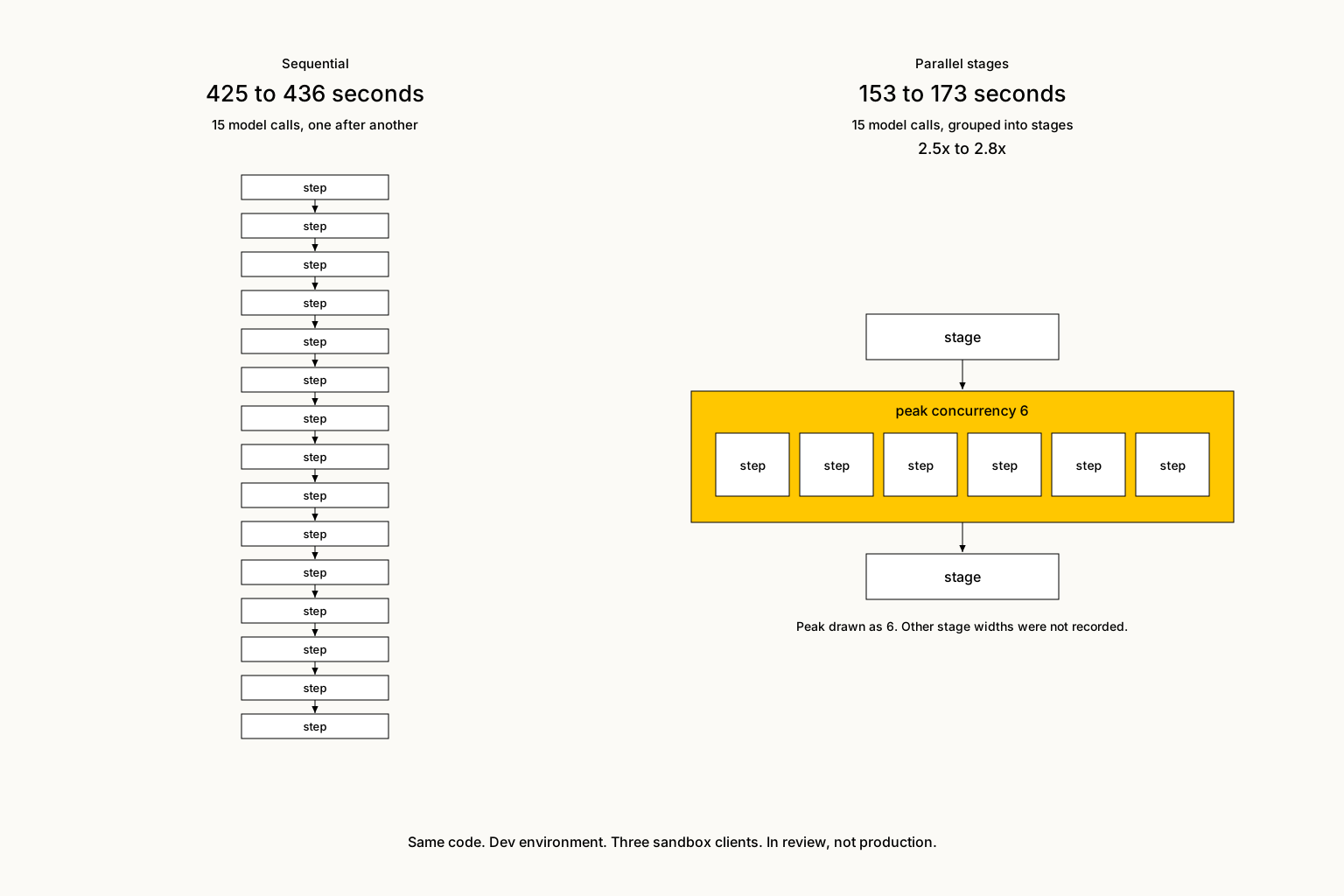
On a multi-firm wealth advisory platform, the financial proposal is 15 model calls across agent steps. In a chain, the same code took 425 to 436 seconds. I measured that in a dev environment, on three sandbox clients.
How does a fractional chief AI officer make AI features faster without raising cost? A fractional chief AI officer makes an AI feature faster without a bigger bill by mapping which of the 15 model calls read which, grouping independent steps into stages, and proving the document still matches before the speedup ships. Same models, same cost. Sequential took 425 to 436 seconds. Parallel took 153 to 173 seconds, 2.5x to 2.8x.
A fractional chief AI officer is the part-time executive who owns AI priorities on a stack that already runs, and who proves a faster feature is still the same feature before it ships.
The hub for fractional CTO, fractional CIO, and fractional chief AI officer leadership is fractional CTO for mid-market and PE portcos. The two seats beside it are what a fractional CIO owns and what a CTO of a company owns.
How does the order change?
- Map which steps read which. A step that reads another step cannot start until that output exists.
- Group the independent steps into stages.
- Run both arms on the same code. On this file that was three sandbox clients, in a dev environment.
- Prove equivalence on sections, text, and spend. Every document kept all 34 sections. Total text differed 0.7% to 1.4%, inside run-to-run variance. Spend attribution stayed one unit per step. Model cost per proposal stayed about the same.
- Then ship. This change is in review, not shipped to production. Equivalence was proven before merge. The merge has not happened.
What did the two arms show?
Sequential
- 15 model calls, one after another.
- 425 to 436 seconds.
- Same code as the parallel arm.
- Three sandbox clients, in a dev environment.
Parallel stages
- The same 15 model calls, grouped into stages.
- 153 to 173 seconds.
- 2.5x to 2.8x.
- Peak concurrency 6 per proposal.
- No rate-limit errors.
- Every document kept all 34 sections.
- Total text differed 0.7% to 1.4%, inside run-to-run variance.
- Spend attribution stayed one unit per step.
- Model cost per proposal stayed about the same.
- In review, not shipped to production.
The speed came from the dependency graph, not a different model.
When you do not need this
You do not need a fractional chief AI officer to reorder a pipeline when every step reads the step before it, so there is no independent work to group. You also do not need the speedup if you will not hold the faster document to all 34 sections, to a text difference inside run-to-run variance, and to one unit of spend per step. A shorter clock that drops a section is not a faster proposal. It is a different document.
What should a buyer ask?
A public argument right now is that harness design beats model choice. On this file the model stayed the same, and the clock moved.
Whether the contract says fractional chief ai officer, fractional ai officer, or fractional head of ai, the bar was the same. A portfolio company paying for AI features wants faster output without a bigger bill. The question is not which model is newer. It is whether someone mapped which steps read which, ran both arms on the same code, and proved the sections, the text, and the spend still match.
That proof is the job of a fractional chief AI officer. If you want it before a speedup ships, talk to us.
Related reading
Frequently asked questions
How does a fractional chief AI officer make AI features faster without raising cost?
A fractional chief AI officer makes an AI feature faster without a bigger bill by mapping which of the 15 model calls read which, grouping independent steps into stages, and proving the document still matches before the speedup ships. Same models, same cost. Sequential took 425 to 436 seconds. Parallel took 153 to 173 seconds, 2.5x to 2.8x.
What is a fractional chief AI officer?
A fractional chief AI officer is the part-time executive who owns AI priorities on a stack that already runs, and who proves a faster feature is still the same feature before it ships. The same seat is sometimes called a fractional AI officer or a fractional head of AI. The service page is https://pineapples.dev/services/fractional-chief-ai-officer
What changed between the sequential run and the parallel run?
Both arms ran on the same code. The financial proposal is 15 model calls across agent steps. Sequential took 425 to 436 seconds. Parallel stages took 153 to 173 seconds, 2.5x to 2.8x. Peak concurrency was 6 per proposal. There were no rate-limit errors. Model cost per proposal stayed about the same. This was measured in a dev environment on three sandbox clients.
How do you prove a faster proposal is the same document?
Every document kept all 34 sections. Total text differed 0.7% to 1.4%, inside run-to-run variance. Spend attribution stayed one unit per step. Both arms ran on the same code, so the model did not change between them.
Is this speedup in production?
No. It was measured in a dev environment on three sandbox clients. The change is in review, not shipped to production. Equivalence was proven before merge, and the merge has not happened.
Written by Anthony Wentzel