
AI Strategy
Three systems, three counts: what data governance consulting fixes when dashboards disagree
Published Nov 26, 2026
Data governance consulting: the website sheet, the CRM, and the API view did not agree. Match by lead number and publish only the signed-off table.

Three systems, three counts: what data governance consulting fixes when dashboards disagree
A multi-location healthcare client launched a new self-booking web form on a Monday evening. In the next daily standup we found that the website sheet, the CRM, and the API view did not agree on how many leads had come in. Two people's clean-lead counts for the same day differed, because of duplicate counting.
What does data governance consulting fix when your dashboards disagree? Data governance consulting stops a team from quoting three different lead counts. After a multi-location healthcare client launched a self-booking form, the website sheet, the CRM, and the API view did not agree. We matched each booked lead to its appointment by lead number, asked the operator four questions, and published only the signed-off table.
Data governance consulting is the work of naming one source of truth for each metric, a named owner who signs off before a number leaves the room, and a reconciliation key that ties the rows together.
The hub for this work is data governance consulting. That page names the owner, the definition, the access rule, and the quality check. This page is the morning three systems disagreed on the same leads. Which source is allowed to win sits on data strategy consulting. The sibling on a pipeline that stays green while the metric is empty is data governance best practices. The table a team fills for the owner and the rule is the data governance framework template.
What each system was counting
I did not want a fourth number in the room. I wanted everyone to see that the three views were not three readings of one metric.
| Source | What it counts | Where it double counts or misses |
|---|---|---|
| Website sheet | Submissions on the new self-booking web form. | A form submission is not a consult booked. Counting the form and counting consults booked will not match. |
| CRM | Leads, including those flagged booked. | A lead flagged booked can have no appointment behind it. A reschedule can look like a second booking. Duplicate counting made two clean-lead counts for the same day differ. |
| API view | The leads the API returned for that same day. | It did not agree with the sheet or the CRM. Until each row is matched to an appointment by lead number, a duplicate can be counted again and a lead the others show can be missed. |
How we reconciled before anyone quoted a number
Before anyone quoted a number, we matched each booked lead to its appointment record by lead number, split bookings by who created the appointment (the online form versus the call center), and sent the table plus four questions to the client's operations lead.
- Match each booked lead to its appointment record by lead number.
- Split bookings by who created the appointment: the online form versus the call center.
- Flag every lead marked booked that has no appointment behind it.
- Ask the operator four questions, and wait for the answers.
- Publish only the table the operator signed off.
The four questions were specific. Which automated creator was the booking integration. What was the exact go-live time. Which leads flagged booked had no appointment behind them. Whether an apparent double booking was a reschedule.
The client's operations lead answered all four. The automated creator was the booking integration. They confirmed the exact go-live time. One lead flagged booked, with no appointment behind it, was a test. The apparent double booking was a reschedule.
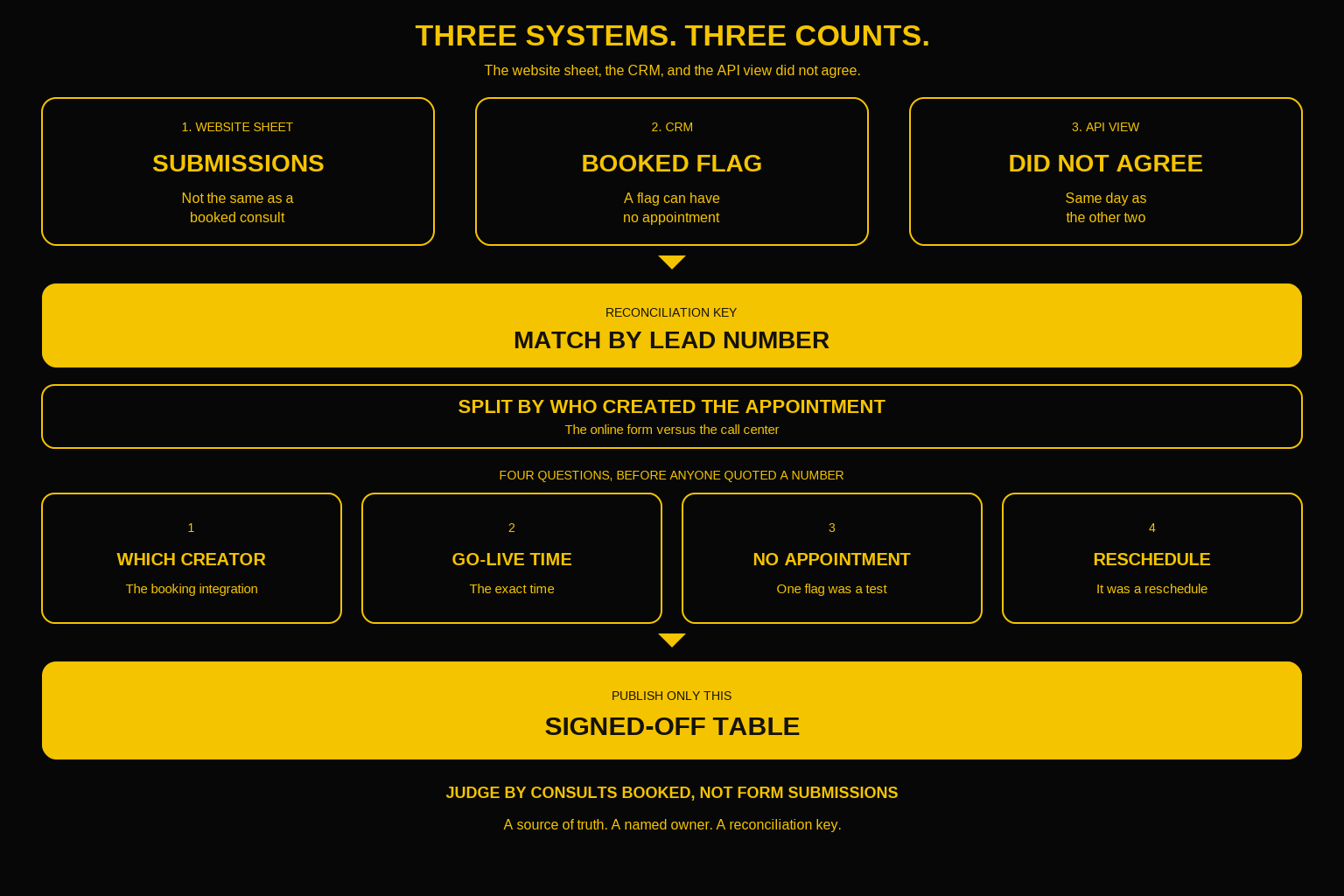
Match by lead number. Ask the operator. Publish only the signed-off table.
What we decided
We decided three things, and none of them was a number to drop into a board deck.
Judge the test by consults booked, not form submissions. Reconcile with the client's operator before a number leaves the room. Treat the early read as a signal and keep monitoring until the trend holds.
Early results showed the form was already creating a meaningful share of booked consults, and the reconciled table was the version everyone agreed to use.
Why a buyer should care
Mid-market operators make channel and staffing calls off dashboards that disagree. Lead-number matching plus an operator sign-off is cheap, and it stops a board deck from quoting the wrong number.
That is the job of data governance consulting on a live file. A source of truth per metric: consults booked, not form submissions. A named owner who signs off: the client's operations lead, before a number leaves the room. A reconciliation key: the lead number that ties a booked lead to its appointment.
When you do not need this
You do not need this when one source of truth, one named owner, and one reconciliation key already exist, and the operator has already signed the table you are about to quote. Three systems that do not agree on the same morning are the case that needs the work.
If the open question is which source is allowed to win, start with data governance consulting. Talk to us.
Related reading
Frequently asked questions
What does data governance consulting fix when your dashboards disagree?
Data governance consulting stops a team from quoting three different lead counts. After a multi-location healthcare client launched a self-booking form, the website sheet, the CRM, and the API view did not agree. We matched each booked lead to its appointment by lead number, asked the operator four questions, and published only the signed-off table.
What is data governance consulting?
Data governance consulting is the work of naming one source of truth for each metric, a named owner who signs off before a number leaves the room, and a reconciliation key that ties the rows together. On this file the source of truth was consults booked, the owner was the client's operations lead, and the key was the lead number.
How do you reconcile a website sheet, a CRM, and an API view?
Match each booked lead to its appointment by lead number. Split bookings by who created the appointment, the online form versus the call center. Flag every lead marked booked that has no appointment behind it. Ask the operator which automated creator was the booking integration, the exact go-live time, which booked leads had no appointment, and whether an apparent double booking was a reschedule. Publish only the table they sign.
Why did two clean-lead counts for the same day differ?
They differed because of duplicate counting. A lead flagged booked can also have no appointment behind it, and one of those was a test. An apparent double booking can be a reschedule, and this one was. The reconciled table, after the operator answered, was the version everyone agreed to use.
When can a team skip this reconciliation?
Skip it when one source of truth, one named owner, and one reconciliation key already exist, and the operator has already signed the table you are about to quote. Three systems that do not agree on the same morning are the case that needs the work.
Written by Anthony Wentzel